In brief
"Handles tax forms" means three things. On Dub, Rewardful, Tolt's auto payouts and Reditus's automated route, the platform is the payer of record, the name on the payment, so it collects the forms and the filing is its job. On AffiliateRail and Komissio you are the payer. Switch tax forms on and AffiliateRail collects a W-9 or W-8BEN before the first payout and exports it when your accountant files; on Komissio the forms live with Stripe. Nothing is filed in the tool's name. On five others the pages do not say. Which group you want depends on whether you want your name or a platform's on the payment.
No card. Cancel in one click.
What does "handles tax forms" actually mean?
In shortThree different things. On some platforms the tool is the payer. It collects the forms and files the returns in its own name. On others you are the payer. The tool collects the forms for you and exports them when you file. On the rest, the page does not say. The phrase on the pricing page is the same. The paperwork is not.
I read the tax and payout pages of eleven platforms on 6 September 2026 for this page. Six of them say something about tax forms; five say nothing I could find. The dates are in the sources at the end. I noticed that "tax compliance" appears on several of them. The sentence that decides what it means is usually two clicks away, in the help centre.
Three terms first. The payer of record is whoever's name is on the payment. If a platform holds your money and pays your affiliates from its own account, the platform is the payer. If your own PayPal or Wise account pays them, you are. A tax form here means the document an affiliate gives the payer before payment. A W-9 from a US person, a W-8BEN from anyone else. A payout fee is a slice a platform takes out of the money you send your affiliates. And the payout method is the route the money took: PayPal, Wise, or a bank transfer. The tax forms article covers the forms themselves. This page is about which tool does what with them.
Which platforms are the payer?
In shortDub, Rewardful, Tolt on its auto payouts, and Reditus on its automated route. Each holds your money and pays your affiliates from its side. So the forms sit with the platform, and what each files is whatever its own page says. The fee you pay it covers that work.
Dub's partner overview is the clearest: "For US-based partners, Dub automatically handles tax compliance by collecting W-9 forms and sending out 1099-NEC forms to individuals or entities that received $600 or more in payments for a given fiscal year." That is a platform acting as the payer. It collects, it files, and its partner terms say commissions are deposited via Stripe once the client has paid. One figure to check against the IRS. Dub's page says $600. For payments made after 2025 a law, P.L. 119-21, raised the 1099-NEC threshold to $2,000, and the IRS's Publication 15 carries the new figure. Read both pages before you rely on either number.
Rewardful's Managed Payouts FAQ says the same thing in its own words. Rewardful "handles payouts and tax compliance on behalf of the merchant, bundling everything into one invoice". "Collecting tax information" is part of that. Affiliates go through an onboarding flow that "collects any required tax or identity information based on their country". They may be asked for documents to verify their identity. That last part matters. When a platform is the payer, your affiliates do identity checks with the platform.
Tolt's help centre says a partner must "complete the required tax information and add a valid payout method" before they are included in an auto payouts invoice. The page I read does not say who files what afterwards. So this page does not either. Reditus puts it in one line for its automated route. "Tax compliance is off your plate, since we pay out the affiliates." On its manual route Reditus does not move the money. The paperwork stays with you.
The price of this group is the payout fee. Rewardful's is a flat 3%. Tolt's is 2% plus $8 per bank invoice or 4% by card. The automatic payouts article has each one. The benefit is real. If you never want to think about a W-9, pay a platform to be the payer.
Which platforms collect the forms and leave the filing with you?
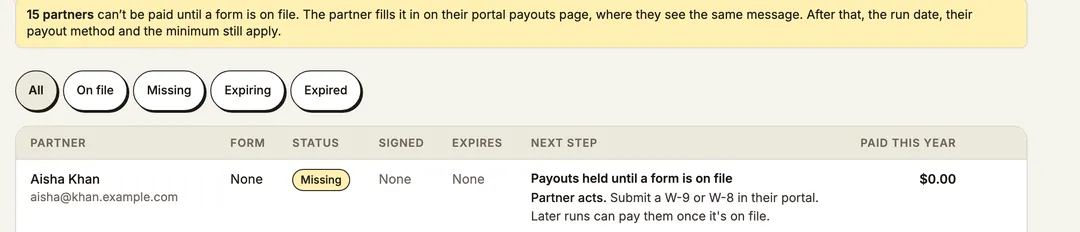
In shortAffiliateRail, and Komissio through Stripe's own dashboards. On these you are the payer, because your own account sends the money. On AffiliateRail, once you switch tax forms on, the tool collects them before the first payout, stores them, and exports them when your accountant files. On Komissio the forms live with Stripe and the affiliate downloads their own. Nothing is filed in the tool's name.
AffiliateRail's payouts guide is explicit, and it starts with a switch. "If you switch require tax forms on, partners complete a W-9 (US persons) or W-8BEN / W-8BEN-E (everyone else) in their portal before they can be paid." Then: "Forms are collected, encrypted and stored for you as the payer of record, and exported as CSV or PDF from Tax forms in the dashboard when you or your accountant file. We never file for you". Tax form collection is on the Grow plan and above. The reason is in the same guide. Your own PayPal or Wise account pays your partners, so "tax paperwork stays yours".
Komissio pays through Stripe Connect from your Stripe account. Its own guide describes the Express dashboard Stripe gives each affiliate. There they "can see their payouts, update their bank info, and download tax forms". So the forms live with Stripe. The affiliate pulls their own, and the merchant remains the payer. The Stripe Connect article covers who files what on that route.
This group's benefit is the other side of the first group's. Your name is on every payment. On AffiliateRail your affiliates do no identity checks with anyone but you, and nothing about your program's paperwork lives in someone else's filing. On Komissio the identity check is Stripe's. The cost, on both, is that filing is your job, with an export or Stripe's records to do it from.
| Platform | Who is the payer | What the page says about tax forms |
|---|---|---|
| Dub | Dub, via Stripe | Collects W-9 forms and sends 1099-NEC forms at $600 or more, per its help page |
| Rewardful | Rewardful, on Managed Payouts | "handles payouts and tax compliance on behalf of the merchant"; collects tax and identity information at onboarding |
| Tolt | Tolt, on auto payouts | Partners must "complete the required tax information" before inclusion; who files is not stated on the page read |
| Reditus | Reditus, on the automated route; you, on the manual one | "Tax compliance is off your plate, since we pay out the affiliates" |
| AffiliateRail | You | Once you switch tax forms on: W-9, W-8BEN or W-8BEN-E in the portal before the first payout, exported as CSV or PDF; never filed for you |
| Komissio | You, from your Stripe account | Affiliates download their own forms from Stripe's Express dashboard, per Komissio's guide |
| PartnerStack, Impact.com, Refgrow, refVenue, Endorsely | Varies | Not stated on the pages read for this article. Ask. |
Why does the payer of record decide which form gets filed?
In shortBecause the IRS forms are addressed to whoever paid. And how the money moved changes which form it is. Money sent through a payment processor is reported by the processor on a 1099-K. Money sent straight from a bank is where a 1099-NEC from the payer normally applies. Get that wrong and the same money is reported twice.
AffiliateRail's year-end guide spells out the trap. "A merchant who files a 1099-NEC for a payment the processor has already reported on a 1099-K has reported the same money twice, and the affiliate is the one who has to sort it out." So the guide's export "tells you what you paid, to whom, and by which payout method, and stops there". It does not name a form, on purpose. Your accountant does that from the payout method column.
For example, take twenty affiliates paid from your own account. Let's say twelve are paid through PayPal Payouts and eight by direct bank transfer. The processor reports the twelve PayPal payments on a 1099-K. Your 1099-NEC question is then only about the eight paid by bank transfer. And only those paid $2,000 or more in the year, the threshold for payments made after 2025. One export, sorted by payout method, and the accountant is done in an afternoon.
Now put a platform in the middle as the payer. Its name is on the payment. So the form is its problem, and so is the double-reporting question. That is a genuine service. It is also why it comes with a fee. The platform is carrying a job the IRS addresses to the payer.
What about affiliates outside the US?
In shortA W-8BEN from each of them, whichever tool you use, and two questions for your accountant. The IRS says where the work was done decides whose income it is. And Form 1042-S is the return that reports payments to foreign persons, filed in some cases even when nothing was withheld. A platform that is the payer is the withholding agent, so both questions are addressed to it. A tool that collects the forms hands both to you, with the forms.
The rules are short and they are the IRS's own. Publication 515 is "for withholding agents who pay income to foreign persons". It says "the place where the services are performed determines the source of the income, regardless of where the contract was made, the place of payment, or the residence of the payer". An affiliate promoting you from Lisbon did the work in Lisbon. If any of the money does count as US-source, the same publication sets 30% withholding unless a treaty lowers it. The 1042-S instructions say you file the form "even if you did not withhold tax" where a treaty or the law made the income exempt. Whether that reaches your payments is the accountant's call.
Two housekeeping facts sit beside those. A W-8BEN lasts to the end of the third calendar year after it is signed. So a tool that collects it should also tell you when it expires. And a US person who never gives a taxpayer number faces backup withholding at a flat 24%. That is the reason AffiliateRail holds the payout until the form is in, once you switch tax forms on.
None of this is tax advice. It is what the IRS pages say, linked below with the day each was read. The decisions are your accountant's. They are easier with the forms and the payout method in one export.
What should you ask a vendor before you sign?
In shortFour questions. Whose name is on the payment? Which forms do you collect, and from whom? Do you file, or do you export? And can I get every form and every payment out as a file when I leave?
Whose name is on the payment sorts every vendor on this page into a group. If the answer is the platform's, expect a payout fee. Expect your affiliates to do identity checks with it too. If the answer is yours, expect an export and a job in January. Neither is wrong. Pick the one you want, knowingly. The regulators' texts explain why the two designs are priced so differently.
Which forms, from whom should be a list. W-9 from US persons. W-8BEN or W-8BEN-E from everyone else. Collected before the first payout and re-collected when they expire. A vendor that names both kinds has thought about both kinds of affiliate.
File or export is the difference between the two groups. The answer should be plain. "We handle tax compliance" tells you nothing. "We file 1099-NEC forms in our name" tells you everything. So does "we export a CSV and never file".
Getting out matters because the forms belong to the payer. If the platform was the payer, the history of what was filed is the platform's. You will want copies before you close the account. If you were the payer, the forms should leave with you as a file. Ask before you have anything to lose.
Collect every tax form before the first payout, and export them when you file
Switch on required tax forms and each partner is asked for a W-9 or W-8BEN in their portal. Their payout waits until it is in. Fourteen days, no card.
Every claim about another platform on this page was read off that platform's own page, on the date beside it in the sources. Where the pages read said nothing, the table says so, and the pack behind this page lists which pages those were. Tell us if a page has changed and we will move the date.
Common questions
Which affiliate software collects W-9 and W-8BEN forms?
Dub collects W-9 forms and files 1099-NEC forms as the payer, per its help page. Rewardful collects tax and identity information on Managed Payouts. Tolt requires partners to complete tax information before an auto payout. AffiliateRail, once you switch tax forms on, collects a W-9, W-8BEN or W-8BEN-E in the portal before the first payout and exports them; it never files. Komissio's affiliates download their own forms from Stripe's dashboard.
Does AffiliateRail file 1099 forms for me?
No, on purpose. Your own PayPal or Wise account pays your affiliates, so you are the payer of record and the forms are yours. Switch tax forms on and AffiliateRail collects them before the first payout, stores them, and exports them as CSV or PDF, with a year-end export that says who you paid, how much, and by which payout method. Your accountant decides which form applies.
What is the 1099-K against 1099-NEC trap?
Money sent through a payment processor is reported by the processor on a 1099-K. Money sent by direct bank transfer is where a 1099-NEC from the payer normally applies. File a 1099-NEC for a payment already on a 1099-K and the same money is reported twice, and the affiliate has to sort it out. Sort your export by payout method before you file.
Is the 1099-NEC threshold $600 or $2,000?
For payments made after calendar year 2025 a law, P.L. 119-21, raised it from $600 to $2,000, and the IRS's Publication 15 carries the new figure. Some vendor help pages still say $600. Check the IRS page linked below and your own year before you rely on either figure.
What do I collect from an affiliate outside the US?
A W-8BEN, or a W-8BEN-E if they invoice as a company, valid to the end of the third calendar year after signing. Then two questions for your accountant: whether any of the payment counts as US-source income under Publication 515, and whether Form 1042-S applies, which the IRS says is filed even when nothing was withheld.
Where these facts come from
Fact-checked and reviewed by Jimi Barkway on 6 September 2026. Every figure above was read off the document named here on the date beside it. To contact AffiliateRail about one, email support@affiliaterail.com and the figure is corrected and the date moved.
- Dub's partner overview: W-9 collection and 1099-NEC filing at $600 or more for US partnerschecked 6 September 2026
- Dub's partner terms: commissions deposited via Stripe once the client has paid in fullchecked 5 September 2026
- Rewardful's Managed Payouts FAQ for merchants: tax compliance handled on the merchant's behalf, tax and identity information collected at onboardingchecked 6 September 2026
- Tolt's help centre on auto payouts: partners must complete the required tax information before inclusion in an invoicechecked 6 September 2026
- Reditus's help centre on automated payouts: tax compliance off your plate because Reditus pays the affiliateschecked 6 September 2026
- Komissio's guide to paying affiliates with Stripe Connect: the Express dashboard where affiliates download tax formschecked 6 September 2026
- AffiliateRail's payouts guide: W-9, W-8BEN and W-8BEN-E collected in the portal on Grow and above, exported as CSV or PDF, never filedchecked 6 September 2026
- AffiliateRail's US year-end guide: the 1099-K against 1099-NEC split by payout method, and why the export names no formchecked 6 September 2026
- IRS Publication 15 (2026): the 1099-NEC threshold raised from $600 to $2,000 for payments made after 2025checked 4 September 2026
- IRS Publication 515: withholding agents who pay foreign persons, where a service is performed, the 30% ratechecked 6 September 2026
- IRS instructions for Form 1042-S: filed even when no tax was withheldchecked 6 September 2026
- IRS instructions for Form W-8BEN: valid to the last day of the third succeeding calendar yearchecked 4 September 2026
- IRS Topic 307: backup withholding at a flat 24% when no taxpayer number is givenchecked 4 September 2026