In brief
If your business is in the US, get a tax form from every affiliate before you pay them. A W-9 from Americans, and a W-8BEN from everyone else (W-8BEN-E if they are a company rather than a person). These are the forms telling the IRS who you paid. From 2026 you only have to report an affiliate once you have paid them $2,000 in a year, up from $600. The figure rises with inflation from 2027, and your affiliate still owes tax below it. If your business is outside the US, this is a VAT question instead. The usual answer is that your affiliate charges you no VAT, and you write the invoice on their behalf.
No card. Cancel in one click.
Do you need a W-9 or a W-8BEN from your affiliates?
In shortIf your business is in the US, yes, from every affiliate, before the first payout. A US person gives you a W-9, and a non-US person gives you a W-8BEN. If they are a company, it is a W-8BEN-E.
Two forms, one job each. A W-9 is the form a US person uses to give you their taxpayer number. That is the number the IRS files them under. A W-8BEN is the form a non-US person uses to tell you they are not American. So the rules written for Americans do not apply to them.
Collect them before you pay, never afterwards. For example, ask before the first payout, and the form is one more box when they join, so everybody fills it in. Ask after the first payout instead, and now you are asking a favour of someone who already has your money. Some of them never answer.
In AffiliateRail this is a single switch. Turn on required tax forms, and every partner then gets asked for a W-9 or W-8 in their own portal. Their payouts remain switched off until it arrives. The forms are stored and exported to you, and never filed anywhere, because you are the one making the payments. The payouts guide has the detail.
What is the 1099 threshold in 2026?
In shortFor payments made in 2026, the reporting threshold for Form 1099-NEC is $2,000 in a calendar year. It was $600 for decades. From 2027 it moves with inflation, so check it every January.
The change came from Public Law 119-21, signed in July 2025. The IRS puts it in one sentence:
For payments made after calendar year 2025, P.L. 119-21 increases the information reporting (for example, Forms 1099-MISC and Forms 1099-NEC) payment threshold from $600 to $2,000 in a calendar year for certain payments to persons engaged in a trade or business and payments for services.
Most articles you will find still say $600. They are out of date. The 1099-NEC instructions carry the new figure, and say it may be adjusted for inflation from 2027. The law itself is on govinfo, if you want the source of the source.
Two things that threshold does not mean. It does not make small payments tax free, and the IRS says so plainly on its 1099-K page. Whether or not a form arrives, the income must be reported. And the threshold belongs to one particular form. Which form you file depends on how the money reached them, and that is the next question.
Who is the payer of record?
In shortPayer of record means whoever's name is on the payment. If the money leaves your account and arrives in the affiliate's, that's you. If a platform holds your money and pays it out, the platform stands in the chain. Then the paperwork has a middleman in it.
That one label answers three questions at once. Whose name is on the payment. Whose paperwork this is. And who the affiliate emails when something goes wrong.
Software that never touches the money keeps the answer straightforward. Keep it that way. AffiliateRail works out who is owed what, then instructs your own PayPal or Wise account to pay. The payment is yours, from you, and the forms are yours to collect and yours to file. The custody page sets out the two models side by side.
How you paid changes which form the payment shows up on. Pay through a network like PayPal, and the processor typically reports it for you on a Form 1099-K. Send it directly from your bank instead, and it leans towards your own 1099-NEC. Let's say the same affiliate is paid half by PayPal and half by bank transfer in one year. That is two separate questions wearing one name. This page will not tell you which form to file. Your accountant will. The export is built to make that quick.
What happens if an affiliate never sends the form?
In shortBackup withholding is money the payer holds back. It goes to the IRS instead of to the payee. The US rules set it at a flat 24% when a payee will not provide their taxpayer number. Whether that bites on your payments is a question for your adviser, so the clean fix is to never discover. No form, no payout.
Three more rules that decide a sentence in your process.
A W-8BEN expires. It runs from the day it is signed, and expires on the last day of the third calendar year after that. The IRS gives its own example in the W-8BEN instructions. A form signed on 30 September 2015 was valid through 31 December 2018. Diarise the expiry. A form you filed away forever is a form that quietly stopped working.
Where the work happened decides whose income it is. Publication 515 says the place a service was performed is what counts, whatever the contract says and wherever the money came from. An affiliate promoting you from their own country performed the work there, and that matters. The US might count some of the money as earned inside the US. Then the same publication sets a 30% withholding rate on payments to foreign people, unless a tax treaty reduces it. Whether any of your payments count is the first question on the accountant list below.
Form 1042-S gets filed even when you withheld nothing. The instructions say so. You file it even if no tax was held back, and that covers a treaty or the law making the income exempt. So your adviser may say those rules apply to your payments. Then the form still exists whether or not any money was kept back.
What does a UK or EU founder do?
In shortOutside the US this becomes a VAT question rather than a forms question. A commission is a payment for a service. When one business buys a service from another, VAT is handled in the buyer's country. You are the buyer, so you account for the VAT yourself. That is called the reverse charge. And you write your affiliate's invoice for them.
The UK rule is in VAT Notice 741A. Paragraph 6.3 says a service sold business to business counts as supplied where the customer is. Paragraph 5.1 says you handle the VAT yourself when three things hold. The supplier is overseas, you are in the UK, and the service is not exempt. In practice, your affiliate in Portugal adds no Portuguese VAT. You put the UK VAT on your own return, and you claim the same amount back on the same return. For most VAT-registered businesses the two entries cancel each other out. They still have to be there.
The EU rule says the same thing in the VAT Directive. Article 44 covers the place of supply of services to a taxable person. It is the place where that person has established their business. Article 196 says VAT is payable by the person to whom those services are supplied. That applies if the supplier is not established in that Member State. Article 226 adds the wording the invoice must carry where the customer is liable for the VAT: the mention "Reverse charge".
So who writes the invoice? Strictly speaking, the affiliate does, because they are selling you a service. In practice, someone promoting you from their spare room has never written a compliant invoice, not once in their life. Self-billing means you write the invoice on their behalf and send it to them. That is the fix. VAT Notice 700/62 sets three conditions. A signed self-billing agreement with each supplier first, and every invoice marked as self-billed. And a check that they are VAT registered where that applies. AffiliateRail writes a self-billed invoice per payout on the Scale plan. Get your adviser to approve the agreement wording once, then you are finished. The agreement article puts this in writing as a clause.
Two edge cases. The UK VAT registration threshold is £90,000 of taxable turnover in twelve months. If you are under it, different rules apply again. And the EU One Stop Shop will not help you here. The Commission's own page describes it as the scheme for selling to consumers. A commission paid to a business is a different thing.
Which form, from whom?
In shortThe table below is the whole page in one grid. Read your row, then read the accountant list.
| Your business | The affiliate | Collect | The question to settle |
|---|---|---|---|
| US | US person | W-9 before the first payout | Which form the payment lands on: 1099-NEC from you, or 1099-K from the processor. Depends on the payout method. |
| US | Non-US person | W-8BEN (W-8BEN-E for a company), renewed every third year | Is any of the payment US-source? If so, chapter 3 withholding at 30% unless a treaty applies, and Form 1042-S either way. |
| UK | Outside the UK | A self-billing agreement, then a self-billed invoice per payout | The reverse charge on your VAT return. Nothing to withhold. |
| EU | Another EU state or outside the EU | A self-billing agreement, then a self-billed invoice marked "Reverse charge" | Article 196: you account for the VAT. The One Stop Shop does not apply. |
| UK or EU | US person | A self-billing agreement | Nothing from the IRS applies to you as the payer. The affiliate's own US return is their business. |
Collect every tax form without sending one email
Each partner is asked on their first visit, and their payout waits until it is signed. Fourteen days, no card.
What do you collect before the first payout?
In shortFour things. The form, the payout details, the agreement to your terms, and a line in your own calendar for the day the form expires.
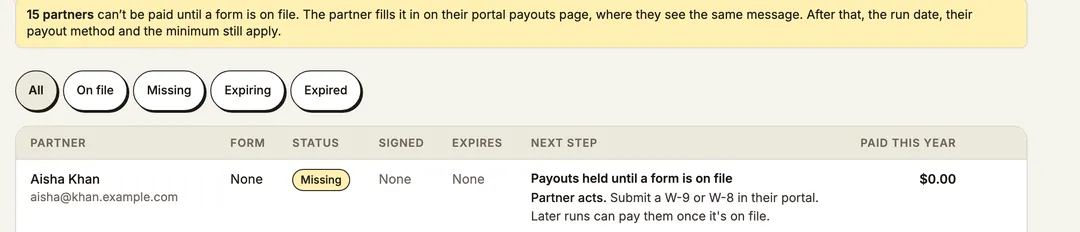
- The form. W-9 or W-8BEN if you are in the US; the self-billing agreement if you are not, in the portal, as a step that blocks the payout.
- The payout details. A PayPal email or a bank account, checked by the payment provider as they type it.
- The accepted terms. Which version, and when. The self-billing clause lives here.
- The expiry. A W-8BEN runs to the end of the third calendar year, so put the date somewhere that will remind you.
If you already have affiliates and no forms, send this today. It works because it is short, and because it names the day the payout waits on. And it says where the form goes, which is nowhere but your own files.
The message to send affiliates who have not sent a form
Subject: One form before your next payout
Hi [first name],
Quick one: before the next payout run on [date] I need a tax form from you, and it takes about two minutes in your portal: [link].
If you are a US person it is a W-9. If you are not, it is a W-8BEN (W-8BEN-E if you invoice as a company). Nothing is filed anywhere, and it is kept on file so the payment can go out.
Payouts without a form on file have to wait, so the sooner the better. Reply here if anything in the form is confusing, and I will walk you through it.
Thanks,
[your name]
When do you phone an accountant?
In shortBefore the first payout run, not at filing season. Bring these five questions, because each one is a decision this page cannot make for you.
- Can a non-US affiliate promoting to a worldwide audience have US-source income, and does any of it come from US servers or US visits?
- If the business is outside the US and pays non-US affiliates, does US backup withholding apply to any payment at all?
- Does the self-billing agreement wording meet Notice 700/62, and which suppliers must be VAT registered for it to hold?
- An EU sole-trader affiliate under their local threshold: does Article 196 still put the VAT on you?
- Moving from a platform that held the money to paying direct: does that change any registration, in a US state or an EU member state?
Bring the export with you. AffiliateRail's annual export lists who you paid, how much, and by which payment method, one row per partner per method. No column guessing at which form applies, and that is deliberate. Your accountant sorts the rows in minutes, which beats rebuilding a year of payments in January.
This page is general information about how the rules are commonly understood, and it is not tax or legal advice. Every figure on it is linked to the IRS, HMRC or EUR-Lex page it came from. The day it was checked sits beside it, in the list at the end.
Common questions
Do I still need a W-9 if I pay affiliates through PayPal?
Collect it regardless. The form is how a US person gives you their taxpayer number. You want it before the first payment, whichever way the money travels. Which form you then file depends on how the money moved, and so does whether the processor files one instead. That part is your accountant's decision. The export puts the deciding facts in one place.
Does the $2,000 threshold mean payments under it are tax free?
No, the threshold changes who has to report the payment, not what the affiliate owes. The IRS says so in plain words: whether or not a form arrives, the income must be reported.
How long does a W-8BEN last?
From the day it is signed, and it ends on the last day of the third calendar year after that. The IRS gives its own example: a form signed on 30 September 2015 ran to 31 December 2018. Diarise the expiry, and collect a fresh one.
My company is in the UK. Do I need a W-8BEN from a non-US affiliate?
The W-8 forms exist for payments from the US, and a UK company paying a Spanish affiliate has no US paperwork in the chain. So the question turns into a VAT question. Where is the service supplied? Who accounts for the VAT? Who writes the invoice? The UK and EU section above answers those three.
Does AffiliateRail file anything for me?
No, and that is deliberate. AffiliateRail collects the forms in the partner portal and keeps a payout off until a valid form has arrived. It exports who was paid, how much and by which payout method. You or your accountant file. The money never passes through AffiliateRail, so the payer of record is always you.
Where these facts come from
Fact-checked and reviewed by Jimi Barkway on 4 September 2026. Every figure above was read off the document named here on the date beside it. To contact AffiliateRail about one, email support@affiliaterail.com and the figure is corrected and the date moved.
- Publication 15 (2026), Internal Revenue Service: the $2,000 information reporting threshold from Public Law 119-21checked 4 September 2026
- Instructions for Forms 1099-MISC and 1099-NEC (IRS): the $2,000 threshold and the inflation adjustment from 2027checked 4 September 2026
- Public Law 119-21, the enrolled text (govinfo.gov)checked 4 September 2026
- Topic 307, Backup withholding (IRS): the flat 24% rate when no taxpayer number is givenchecked 4 September 2026
- Instructions for Form W-8BEN (IRS): valid to the last day of the third succeeding calendar yearchecked 4 September 2026
- Publication 515 (2026), Withholding of Tax on Nonresident Aliens (IRS): the 30% rate and where a service is performedchecked 4 September 2026
- Instructions for Form 1042-S (2026), IRS: filing even when no tax was withheldchecked 4 September 2026
- Understanding your Form 1099-K (IRS): income must be reported whether or not a form arriveschecked 4 September 2026
- VAT Notice 741A, Place of supply of services (HMRC): the B2B general rule and the reverse chargechecked 4 September 2026
- VAT Notice 700/62, Self-billing (HMRC): the agreement and the markingchecked 4 September 2026
- Register for VAT (GOV.UK): the £90,000 thresholdchecked 4 September 2026
- Directive 2006/112/EC, consolidated text of 1 January 2025 (EUR-Lex): Articles 44, 196 and 226checked 4 September 2026
- The One Stop Shop (European Commission): the schemes for business-to-consumer supplieschecked 4 September 2026
- AffiliateRail documentation: tax forms as a program switch and payout eligibilitychecked 4 September 2026