By Jimi Barkway · Published 1 September 2026 · Updated 3 September 2026 · Part of the honest manual · Every fee on this page was checked against the provider's live pricing on the date shown beside it
The short version
Your program's hardest problem isn't tracking clicks. It's getting $37 to a designer in Manila without losing a slice to hidden exchange spreads. Or creating a tax mess in January. Before your first payout, get four things straight. Who the payer of record is. What PayPal or Wise really charges, including the exchange-rate spread. Which forms to collect before money moves. And why your minimum payout and hold period are trust decisions dressed as settings.
Who is actually paying your affiliates?
There are two ways affiliate money can move. Pick carefully. The difference decides most of what follows.
On a custodial model, you send a lump sum to a platform. The platform holds it, then hands it out to your affiliates. While it sits there it's in someone else's custody. The platform typically takes a percentage for the service. And every question about who reported what to which tax authority now has a middleman in it.
On a non-custodial model, the money goes straight from your account to each affiliate's. Software works out the amounts and instructs your payout method. But the payment itself is yours, from you. You are unambiguously the payer of record.
That isn't jargon to skim past. Payer of record answers "whose name is on the payment, whose paperwork is it, and who does the affiliate chase when it goes wrong". You want that answer in the week you set the program up. Not in January, form deadline looming, while you work out what a platform did or didn't file on your behalf.
Cards on the table. AffiliateRail is non-custodial. We never hold your money. This module describes the world from that side of the line. The useful bit for you: everything below applies whichever software you use. The payout methods, the forms, the arithmetic. Money that stays yours until it lands in the affiliate's account is the simplest version of this problem. So that's the version this module teaches.
PayPal Payouts: what it really costs
PayPal is the default choice for a reason. Nearly every affiliate on earth can open an account. All you need from them is an email address.
The mechanics: upgrade to a PayPal Business account and ask PayPal to switch on Payouts. That's a review that takes a few business days, so do it before you have anyone to pay. Payments then go out from your PayPal balance. That balance is the catch. Payouts draw on the balance only, not your linked bank account. So it needs topping up before each payday.
The fees below are from PayPal's own US merchant fees page, checked 3 September 2026.
- Sending through the Payouts API from a US account costs a flat fee per payment: $0.25 for a payment in US dollars.
- Sending through the web interface instead costs 2% of each payment.
- A payment that crosses borders costs 2%, capped per currency, $20 for US dollars.
- And the one almost nobody says out loud: when PayPal converts the currency, the exchange rate includes a 4% conversion spread. Your affiliate in the Philippines loses that on top of any per-payment fee. It never shows up as a line item anywhere. It's the single biggest hidden cost of PayPal.
Fee schedules differ by the country your business account is registered in. So check your own account's fee page rather than trusting any article older than a few months. This one included.
Two behaviours worth knowing before they surprise you. If an affiliate's email has no PayPal account attached, the payment sits unclaimed for 30 days. PayPal invites them to open an account in that time. If nobody claims it, the money comes back to your balance. And PayPal Payouts doesn't work in every country. So a program with partners everywhere eventually meets someone it can't pay this way. Which is where the second payout method comes in.
Wise Business: the other automated payout method
Wise pays into bank accounts rather than PayPal wallets. That means an IBAN, or an account and routing number for US dollars. That one difference matters. It makes Wise the better choice for affiliates who don't want a PayPal account. Also for anyone in a country where PayPal's withdrawal fees sting.
Wise converts at the mid-market rate, the one you see on a currency chart. It charges its fee separately and visibly. Nothing hides in the rate.
The costs are from Wise's UK business pricing page, checked 3 September 2026. A one-off £50 to open the full business account. No monthly fee. And a transfer fee that varies by currency, from 0.24%. On a $100 payout that's measured in cents. Put it next to a 4% conversion spread. For international payments the comparison isn't close.
Setup takes longer than PayPal's. Expect that. Wise verifies your business before the account opens (allow one to three business days). You fund a balance in the currency you pay from. API access comes through a token your software uses to prepare each transfer. One regulatory wrinkle for UK and EEA businesses. Strong customer authentication means Wise asks you to approve each batch yourself. The exception is if you register a signing key. So "automated" there means "prepared and waiting for your one click". For a monthly payday that's honestly fine. The automation page says which platforms do this without a click.
With either, your affiliates enter their own payout details in their portal. PayPal's or Wise's own checks apply as they type. A mistyped account number becomes an error on their screen. Not a failed payout three days later.
The CSV fallback is fine
If you have four affiliates, you don't need an API integration. You need a list: who, how much, which account. Export it. Open your own PayPal or bank interface. Pay each person, mark them paid. Twenty minutes a month. You also learn what your payout process actually involves, before you hand it to a machine. Payout methods that only do bulk uploads, like Payoneer, work the same way. Generate the batch file in the shape it expects and upload it once. The Payoneer article prices that route against PayPal and Wise.
The moment to automate is when the twenty minutes becomes an hour. Or when you catch yourself postponing payday because it's a chore. A postponed payday is the one operational failure affiliates never forgive. So the honest rule is: manual until it threatens the schedule, automated after.

The tax part nobody writes down
Before you read this section
What follows is general information about how the rules are commonly understood. It is not tax or legal advice. Your own situation is exactly what it can't see. The right time to talk to an accountant is before your first payout run. Not at filing season. Where a specific decision matters below, we say so at that point.
Every guide to affiliate programs mentions paying people. Almost none mention the paperwork that comes with it. The honest version of this section is awkward to write when you sit between the merchant and the money. We don't. So here it is.
Collect the forms before the first payout, not after
If your business is in the US, or pays US persons, two forms matter. A W-9 is how a US person gives you their taxpayer identification. A W-8BEN (or W-8BEN-E for companies) is how a non-US person certifies they aren't one. The W-8 expires after three calendar years. Diarise that. You re-collect it rather than filing it away forever.
Collect before you pay, because the timing does your enforcement for you. Before the first payout the form is a checkbox in onboarding, and everyone fills it in. Afterwards it's a favour you're asking of someone who already has the money. Some will never respond. The US rules also provide for 24% backup withholding on payments where the payee's taxpayer identification is missing. Whether and how that applies to your payments is one for your adviser. But the existence of the rule is a good reason not to design a program where you find out.
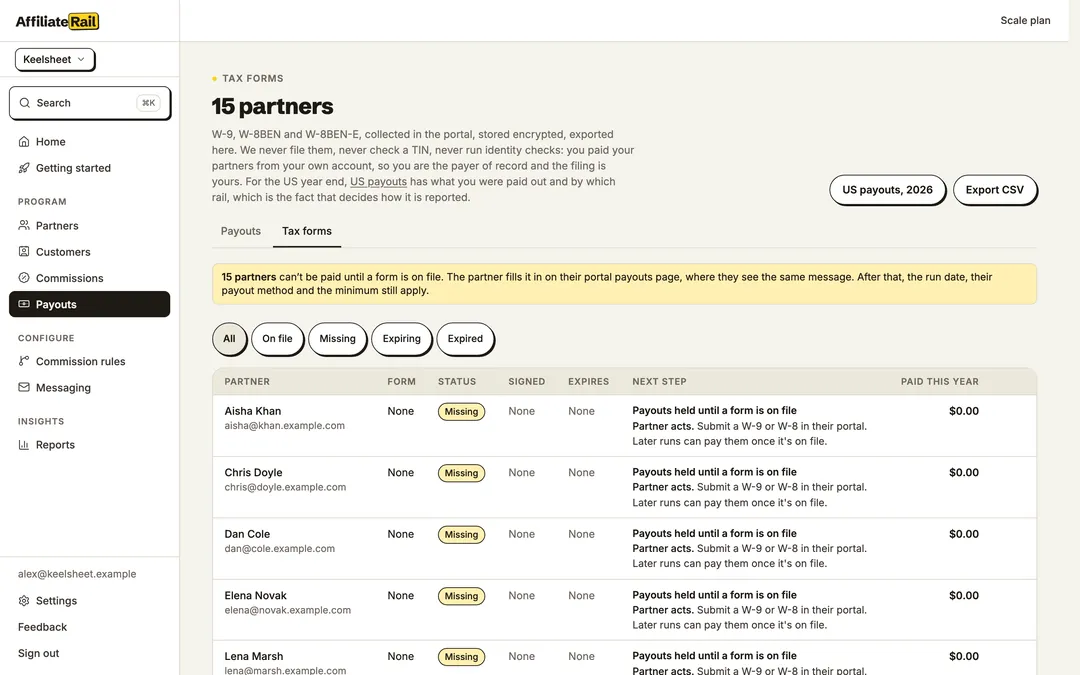
In AffiliateRail this is a switch. Turn on required tax forms and a partner sees the W-9 or W-8 flow in their portal. Their payouts stay ineligible until the form's in. We collect, store and export the forms. We never file anything. The payments are yours, not ours.
The threshold that changed in 2026
For payments made in 2026, the reporting threshold for Form 1099-NEC is $2,000 in a calendar year. It was $600 for decades. The One Big Beautiful Bill Act raised it in July 2025. From 2027 it's indexed to inflation. That means it now moves every year. Most articles you'll find still say $600. They're out of date. Check the current figure each January, or ask your accountant to. We confirmed the figure with our own tax adviser on 25 August 2026. We confirmed it again against the IRS guidance current on 3 September 2026.
For tax years beginning after 2025, the minimum threshold amount for reporting certain payments required to be reported on certain information returns and/or perform backup withholding on those payments increased to $2,000 and may be adjusted for inflation beginning in calendar year 2027.
Two things a threshold doesn't mean. Income below it is still taxable to the person you paid. The threshold changes who must report, not what's owed. And the threshold belongs to a specific form. Which brings us to the part where this module deliberately stops short.
Which form? That depends on how the money moved
Here's the distinction that surprises almost everyone. What you might have to file depends less on how much you paid. It depends more on how you paid it. PayPal is a third-party settlement network. Payments made over one of those are generally reported by the processor itself, on Form 1099-K. So a merchant who also reports the same payments can end up double-reporting them. Direct bank payments, ACH and wire, lean the other way. They lean toward the merchant's own reporting on 1099-NEC. Wise sits near the line. Near enough that the honest answer is your adviser's read on your specific setup.
Notice what that means. Say you paid an affiliate half by PayPal and half by bank transfer. That is two different reporting questions inside the same person. So no, this module won't tell you which form to file. That is deliberate. The answer depends on which payout methods you used and where you are. It also depends on facts about your business we can't see.
What software should do is put the deciding facts in one place. Ours does. The annual payout export lists who you paid, how much, and by which payout method. One row per partner per payment method, with no "form" column. Your accountant classifies each row in minutes. No rebuilding a year of payments in January.
Invoices and VAT, in plain words
Outside the US, the paperwork question is usually an invoice question. An affiliate commission is a payment for a service. The service is marketing, and the affiliate supplied it to you. In most VAT systems a service between businesses is taxed where the customer belongs. Here, that's you. Not the affiliate.
For a UK or EU business paying an overseas affiliate, that usually lands on the reverse charge. The reverse charge is where the affiliate doesn't add their local VAT to the invoice. You account for the VAT yourself on your own return, declaring it and reclaiming it in the same breath. For most VAT-registered businesses the two entries cancel out. No money changes hands. The entries still have to exist. So your bookkeeper wants to hear about your affiliate program before your first VAT return, not after. Below your country's registration threshold, different rules apply again. One more item for the accountant.
Who writes the invoice? Formally the affiliate is the supplier, so it's theirs to issue. In practice, a hobbyist affiliate in another country has never issued a compliant invoice in their life. So the practical answer is self-billing. Self-billing is where, with the affiliate's agreement, you generate the invoice on their behalf for each payout. They get a document for their records. Your books get a paper trail that actually exists. AffiliateRail generates these self-billed invoices on the Scale plan. Some countries put conditions on self-billing, the UK among them. Have your adviser bless the setup once. Then let it run.
Minimums, holds and paydays
Three settings every platform asks for and no platform explains.
The minimum payout. The reflex is $50, borrowed from the ad networks of twenty years ago. For a small SaaS program it's quietly lethal. Run it on your own numbers. 20% of a $29 subscription is $5.80 a month. So when your newest affiliate refers one customer, a $50 minimum makes them wait nine months. That's nine months for the first proof that your program pays real money. Most will decide it doesn't, and stop, long before month nine. A minimum exists to stop you paying out amounts smaller than the fee to send them. $20 does that job. It's our default. On Wise, where sending $20 costs cents, you could defend even lower. Set the smallest number that doesn't embarrass anyone. Then let the first payment do its real job: convincing the affiliate you're worth promoting properly.
The hold period. The gap between a commission being earned and becoming payable exists for one reason: refunds. Pay commissions the day of the sale, and watch what happens when the customer refunds in week three. You're clawing money back from a partner. That is the single most corrosive conversation an affiliate program produces. The clean rule: your hold should be at least your refund window. We default to 14 days. If you offer 30-day refunds, hold for 30. Tell affiliates why in one sentence, and nobody minds. A clawback is money taken back from a partner after you have already paid it. A transparent delay beats one every time.
The schedule. NET-15 means commissions from one month are paid 15 days after the month ends. Some version of monthly-plus-a-buffer is the norm across the industry. The number matters less than its reliability. An affiliate treats your payday the way you treat a customer's invoice date. One missed or silently late payment and the relationship changes for good. Pick a schedule you can keep in your busiest month. Automate it or diarise it. Treat it as immovable.
What a payout actually costs you
Now the arithmetic that decides your software bill. Platforms that hold your money charge for the holding. A common published structure in this category: 2% of every payout, plus fees to fund the platform wallet. Those funding fees are $8 per invoice by bank transfer or 4% by card. The figures are from one such vendor's live pricing and help pages. They are carried with their sources on the comparison page, checked 3 September 2026. Here's what that costs at three volumes, funding by bank transfer.
| You pay affiliates | 2% plus an $8 invoice takes | AffiliateRail takes |
|---|---|---|
| $2,000 a month | $48 a month | $0 |
| $10,000 a month | $208 a month | $0 |
| $50,000 a month | $1,008 a month | $0 |
Fund the same wallet by card at 4% and the middle row becomes $600 a month. Paying $10,000 a month to affiliates through a tool that holds the money and takes 2% costs $2,496 a year. That's before the card option. That is roughly a year of decent affiliate software. Spent on moving money you already had.
To keep the comparison honest: on either model you pay PayPal's or Wise's own charges. That's PayPal's per-payment fee or Wise's 0.24%, because someone has to actually move the money. The percentage on top only exists when a platform stands in the middle of yours. That is the whole difference. We charge 0% of payouts on every plan. We can only do that because the money never passes through us. There's nothing to take a cut of. That's the architecture. It is why no plan of ours will ever grow a payout fee.
Common questions
How do I pay affiliates without a platform holding the money?
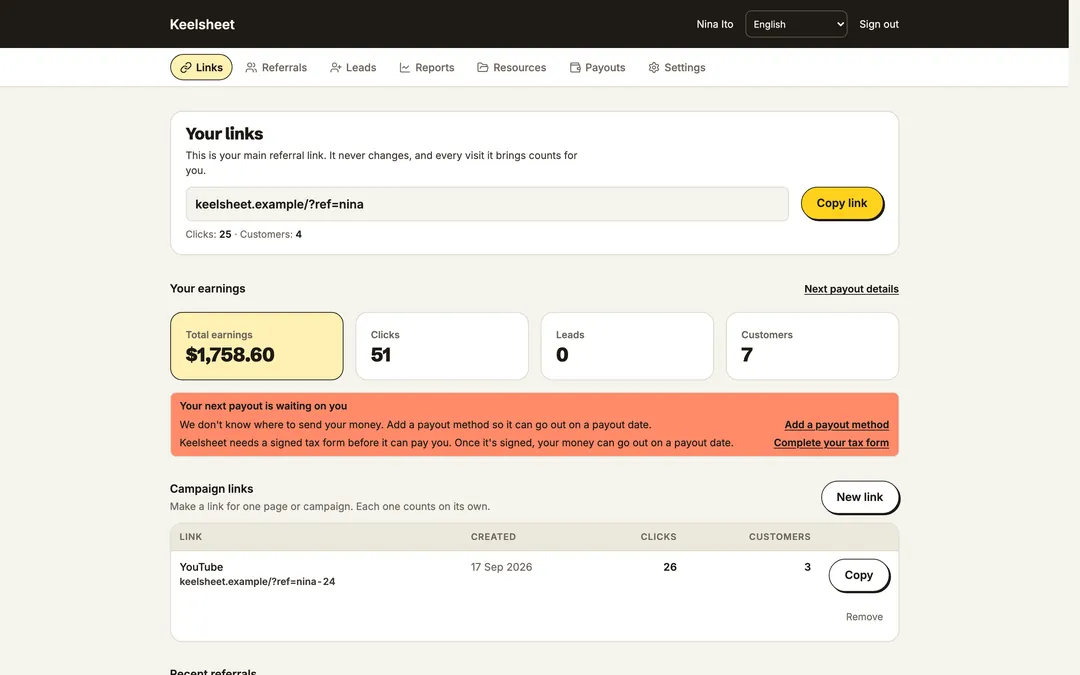
Connect your own PayPal Payouts or Wise Business account to software that works out who's owed what. The software instructs your PayPal or Wise account with your credentials. Or export a batch and pay from your own account by hand. Either way the money moves directly from your account to the affiliate's. You stay the payer of record.
Do I need a tax form from an affiliate before I pay them?
Standard practice for a US business is a W-9 from US persons and a W-8BEN from everyone else. Collect them before the first payout, while the form is still a routine onboarding step. The US rules provide for 24% backup withholding when taxpayer identification is missing. Which information return you later file, if any, depends on how the money moved. So confirm the specifics with your accountant.
What is a sensible minimum payout for a small program?
Low. A 20% commission on a $29 subscription earns $5.80 a month. So a $50 minimum makes a one-referral affiliate wait most of a year to be paid at all. Around $20 filters out processing noise. It doesn't teach new affiliates that the program never pays.
That's the money module. If you haven't read module 0, the disqualifier, read it before you set any of this up. The best payout configuration in the world can't rescue a program that shouldn't exist yet. And once more, because it's the one sentence in this module that protects you. This page is general information. The week before your first payout run is the right week to put your accountant on it.
Where these facts come from
Every figure above was read off the document named here on the date beside it. If one has moved on, email support@affiliaterail.com and we will correct the figure and move the date.
- Instructions for Forms 1099-MISC and 1099-NEC (IRS): the $2,000 threshold for tax years after 2025checked 3 September 2026
- Topic 307, Backup withholding (IRS): the flat 24% ratechecked 3 September 2026
- Instructions for Form W-8BEN (IRS): valid to the last day of the third succeeding calendar yearchecked 3 September 2026
- PayPal merchant fees, United States: the Sending PayPal Payouts table and the currency conversion spreadchecked 3 September 2026
- PayPal Payouts reference: unclaimed payments expire in 30 days and return to the senderchecked 3 September 2026
- Wise Business pricing, United Kingdom: the set-up fee and the sending fee by currencychecked 3 September 2026
- Payoneer mass payouts: the batch uploadchecked 3 September 2026
- Payouts guide: the $20 minimum, the 14-day hold, PayPal and Wise, the manual methods, tax formschecked 3 September 2026
- Program setup guide: the minimum payout, 20.00 by default in your currencychecked 3 September 2026
- US year end and 1099 reporting guide: the export by payout method, and why we do not name the formchecked 3 September 2026
- AffiliateRail pricing: self-billed invoices on Scalechecked 3 September 2026
- The comparison page carrying that vendor's published pricing and help-centre pages, with check dateschecked 3 September 2026
No card. Cancel in one click.