By Jimi Barkway · Published 1 September 2026 · Updated 3 September 2026 · Part of the honest manual
The short version
Affiliate fraud is real. It's rarer than the horror stories, and mostly visible in data you already have. Configure the boring defences on day one. Know the signature of each abuse. Prepare the three awkward messages in advance, because the hard part of enforcement isn't detection. It's saying no to a human without burning the relationship.

Every founder asks the same first question about affiliate fraud. How bad is it? The honest answer comes from the category's own data. The source is FirstPromoter's July 2026 study: 31.4 million referrals across 3,425 programs, July 2026. Figures were re-checked 3 September 2026. In it, about 4% of referrals get flagged for review. Classic self-referral trips only around 0.15%. Fraud is a real cost, not an existential one. The bigger cost is usually something that isn't fraud at all. We'll get to it.
Know each one by its signature
Self-referral. Someone buys your product through their own link. That turns your program into a private discount. Signature: matching emails, addresses or payment details between partner and "customer". This is the one abuse software should catch entirely on its own. We block it by default on every plan.
Brand bidding. The partner runs search ads on your brand name. They tax traffic that was already yours. Signature: a sudden jump in referrals with search as the source. It's timed to nothing the partner published. Worth knowing: in that same study, 96% of all flagged referrals were paid-ad traffic. So say a program's numbers go strange without explanation. Brand bidding is usually where the trail ends up.
Coupon-code leak. A partner's discount code escapes onto coupon sites. Every checkout that hunts for a code hands them credit. Signature: one code's usage suddenly dwarfing its partner's actual audience. Minutes between click and purchase.
Cookie stuffing. Dropping your tracking cookie on people who never meaningfully clicked. Then harvesting credit if any of them ever buy. Signature: clicks way up, conversion rate collapsing toward zero.
Incentivised traffic. The partner rewards people for signing up. Signature: a burst of conversions that churns to nothing inside a month or two. None of them wanted the product.
And the boring one that costs the most: low-quality volume. Not fraud. No rule broken. An entirely sincere partner whose referred customers cancel in month one, every time. No terms clause catches it. Only module 6's habit of watching churn per affiliate does. At most small programs this quietly outcosts all the actual fraud combined.
The boring defences, configured on day one
Most protection is settings, not vigilance. A hold period is how long you sit on a commission before you are allowed to pay it out. Yours wants to be at least as long as your refund window (module 3). Self-referral blocking on. Your blocked traffic sources and brand keywords listed. And the terms from module 2 naming what's banned, in writing, before anyone joined. Those blocking safeguards ship on every plan of ours.
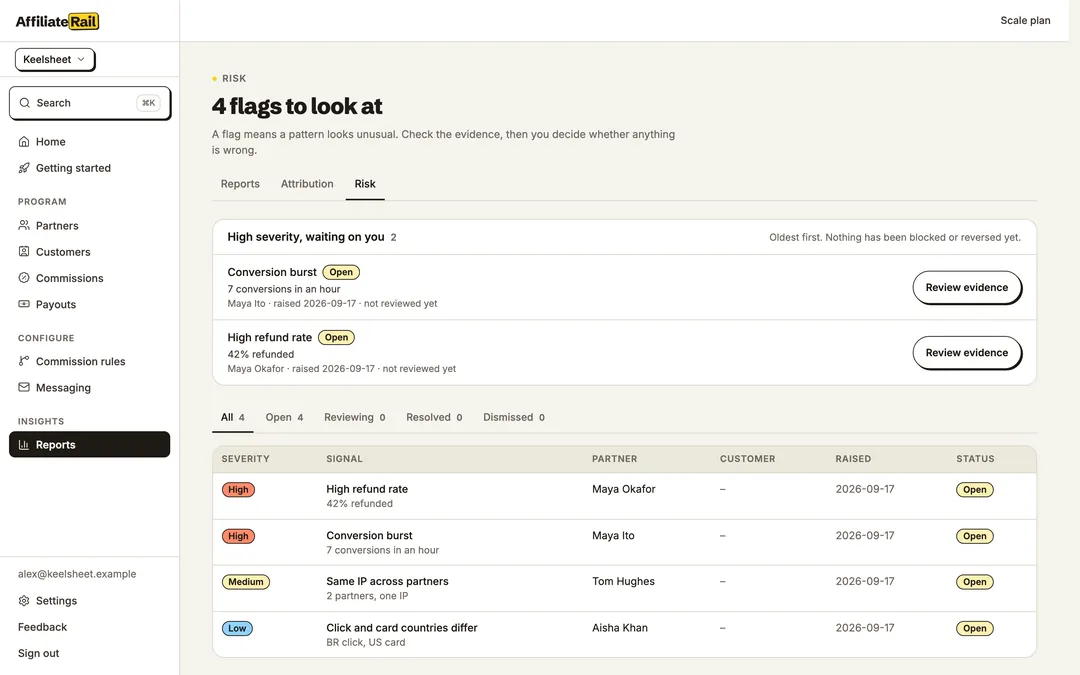
On top of that sits monitoring. Flags raised against referrals and payouts, with the evidence attached (on our Scale plan). That matters for one specific reason. You want to act on evidence, not vibes. Every action below starts with being sure.
The part nobody publishes: the actual words
Detection is the easy half. The hard half is that enforcement means messaging a real person and telling them no. Often one with an audience. Founders postpone that conversation for weeks. The delay costs more than the fraud. So here are the three messages, ready in advance.
Rejecting an application
Hi [name], thanks for applying. I'm going to say no for now. We're keeping the program small and focused on partners whose audience closely matches our buyers. From what I can see that's not quite you yet. That can change, and if it does you'd be welcome to apply again. Good luck with [their actual thing].
Short, honest about the reason, and it leaves the door visibly open. What it never does is invent a fake capacity excuse. People compare notes.
First offence, assuming good faith
Hi [name], flagging something before it becomes a problem. We're seeing referrals from paid search ads on our brand name. Our terms don't allow that (clause 1, agreed when you joined). I'm assuming this wasn't deliberate. Possibly it's an agency or a tool on your side. Commissions from those clicks will be reversed. If the ads stop this week we're completely fine. Any questions, reply here.
The generous read is doing real work. Half the time it genuinely was an agency. The partner keeps their dignity while the behaviour stops either way. Firm on the facts, warm to the person.
Ending it
Hi [name], we spoke on [date] about brand-bid traffic and it's continued. So I'm closing your account under our terms, effective today. Commissions on legitimate referrals to date will be paid out on the normal schedule. The flagged ones are voided. This isn't a conversation I enjoyed arriving at, and it's final.
Two things in that last message do the heavy lifting. Paying the legitimate balance signals the process was fair. That is what everyone watching will ask about. And "final" saves you the three follow-up emails asking for another chance.
When to eat the loss
Not every flag deserves the full process. A $9 commission with ambiguous evidence isn't worth an accusation that might be wrong. Void it quietly or let it stand, and watch for a repeat. Save the confrontation for clear evidence and meaningful money. You're running a program, not a courtroom. Being known as fair is worth more than any single clawback. A clawback is money you take back from a partner after you have already paid it.
What do founders ask about fraud?
How common is affiliate fraud?
FirstPromoter's July 2026 study covers 31.4 million referrals across 3,425 programs. In it, about 4% of referrals get flagged for review. 96% of those flags are paid-ad traffic.
Which defences should be on from day one?
A hold period at least as long as your refund window. Self-referral blocking on. Your blocked traffic sources and brand keywords listed. And terms that name what is banned before anyone joins. Most protection is settings, not vigilance.
When should I let a flag go?
When the evidence is ambiguous and the money is small. A $9 commission is not worth an accusation that might be wrong. Void it quietly or let it stand, and watch for a repeat. Save the confrontation for clear evidence and meaningful money.
One module left, and it's the strange one. It's module 8, when to stop paying attention to all of this.
Where these facts come from
Every figure above was read off the document named here on the date beside it. If one has moved on, email support@affiliaterail.com and we will correct the figure and move the date.
- FirstPromoter's July 2026 referral dataset: 31.4 million referrals across 3,425 subscription programschecked 3 September 2026
- Safeguards and risk guide: the checks on every plan and hourly monitoring on Scalechecked 3 September 2026
No card. Cancel in one click.