In brief
PayPal Payouts, the service that used to be called Mass Pay, sends one batch to many affiliates from your own business account. It costs 0.25 USD a payment by API in US dollars, or 2% capped at $1.00 through the website. Across borders it is 2% capped at $20.00, and if PayPal converts the currency a 4.00% spread comes off the exchange rate. It reaches over 156 countries. A payment to someone with no PayPal account waits 30 days, then comes back to you. Cheap for dollars to the US, expensive for anything that changes currency.
No card. Cancel in one click.
Can you pay affiliates through PayPal?
In shortYes, and most small programs do. The product is called PayPal Payouts. It used to be called Mass Pay. It sends one payment to many people at once, from a PayPal business account. Every affiliate needs a PayPal or Venmo account, or the chance to open one.
The research method was simple. I read PayPal's own business fee page and its Payouts documentation on 6 September 2026, then set the rates against one worked batch of thirty payments. I found that the per-payment cap, and not the percentage, decides the bill on a small program.
PayPal's own fee page says Payouts "includes the service formerly known as Mass Pay". The next sentence is the one that matters for your budget: "We charge you a fee for each payment you send using PayPal Payouts."
So the shape is this. You hold a PayPal business account. Your affiliates give you the details PayPal needs to find their account. On payday you send a batch. You upload a file yourself, or software calls PayPal's Payouts API for you. An API is the doorway software uses to send the batch. Each affiliate gets a payment. You get a fee per payment.
I read PayPal's developer FAQ, its payment processing page and its US business fee page on 6 September 2026 for the figures below. I noticed the Payouts fee tables and the conversion spread sit in different sections of that page, hundreds of lines apart. So the table below puts them together. The fee page was last updated on 1 September 2026. So this is current as I write. Check the page yourself before you plan on any number here.
What does PayPal charge to pay an affiliate?
In shortFour numbers. In the US, 2% of each payment capped at $1.00 sent the standard way. Or a flat 0.25 USD per payment through the API. Across borders, 2% capped at $20.00. And if PayPal converts the currency, a 4.00% spread on the exchange rate on top.
The fee page splits payouts into two tables. The first is the rate. For a US account paying a US recipient it is "2% of total transaction amount (not to exceed the maximum fee cap below)". For the API it is a flat rate instead. The second table gives the caps by currency. For US dollars the standard cap is 1.00 USD. The API flat fee is 0.25 USD. The international cap is 20.00 USD.
Let's say you pay a US affiliate $100 the standard way. That is $1, because 2% of $100 is $2 and the cap is $1. Send the same $100 through the API and it is 0.25 USD. A batch of 50 affiliates at $100 each is $5,000. It costs $12.50 in API fees. Those are small numbers. They are why PayPal is the default choice for programs paying dollars to people in the US.
Now pay an affiliate abroad. The rate is still 2%, but the cap rises to $20.00 for US dollars. So a $100 payment costs $2 and a $1,000 payment costs $20. Then comes the number no affiliate tool prints on its pricing page. A spread is the gap between the real exchange rate and the rate you are given. Say your affiliate's PayPal account is in another currency and PayPal converts it. The fee page says the exchange rate then includes "4.00%, or such other amount as may be disclosed to you during the transaction". On the $100 payment that is about $4 more, taken from the affiliate's side. The $2 fee was yours, so they receive about $96 of value. It never shows up as a line item. It is the single biggest cost of PayPal for an international program.
| A $100 payout | PayPal's rate | What it costs |
|---|---|---|
| To the US, the standard way | 2%, capped at 1.00 USD | $1 |
| To the US, through the API | Flat 0.25 USD | 0.25 USD |
| Abroad, same currency | 2%, capped at 20.00 USD | $2 |
| Abroad, PayPal converts it | 2% capped at 20.00 USD, plus a 4.00% spread on the rate | $2 to you, about $4 off what they receive |
One relief. Recipients pay nothing to receive. The developer FAQ says "Payout recipients pay no fee regardless of the type of PayPal account they have." The sender pays the fee. The affiliate pays the spread, if there is one, through the rate.
How many affiliates and countries can it reach?
In shortA lot. PayPal says Payouts "are supported in over 156 countries in over 23 currencies". There is no limit on the total size of a batch. Each single payment is capped at $20,000.00 USD by default.
Two limits to know before they surprise you. The cap is per affiliate, per payment. So a top affiliate owed more than $20,000 in one month needs two payments. Or, in the FAQ's words, you "contact your account representative or Customer Service". And three currencies are named as ones PayPal will not convert into. The developer FAQ says "currency restrictions do not allow conversion of Argentine Pesos, Brazilian Real, or Malaysian Ringgit". So a payment cannot be converted into those three.
The reach is the reason PayPal wins by default. Nearly every affiliate on earth can open an account. A Venmo account works too, because the processing page names both. All you need from them is an email address. The manual's chapter on payout methods puts PayPal beside Wise for exactly that trade. PayPal asks less of the affiliate. Wise converts cheaper.
What happens when an affiliate has no PayPal account?
In shortThe payment waits for them. PayPal notifies the recipient that money is available. If nobody claims it within 30 days, the money comes back to your account.
PayPal's processing page describes it: "recipients that already have a PayPal or Venmo account get their payment instantly. Recipients without a PayPal or Venmo account receive a notification that a payment is available. If a payment is unclaimed after 30 days, the money is returned to your account."
Often this is not a failure at all. It is a mistyped email, or an affiliate who signed up with one address and uses PayPal on another. The fix is upstream. Collect the PayPal email in the affiliate's own portal, so it is theirs to get right, and confirm it before the first batch. The PayPal integration page sets out how a batch runs and what happens to an unclaimed payment.
How do you run a payout batch?
In shortTwo ways. Send the batch to PayPal yourself, the standard way. Or connect your PayPal business account to software that calls the Payouts API. It then sends the batch on a schedule. Either way the money leaves your own account.
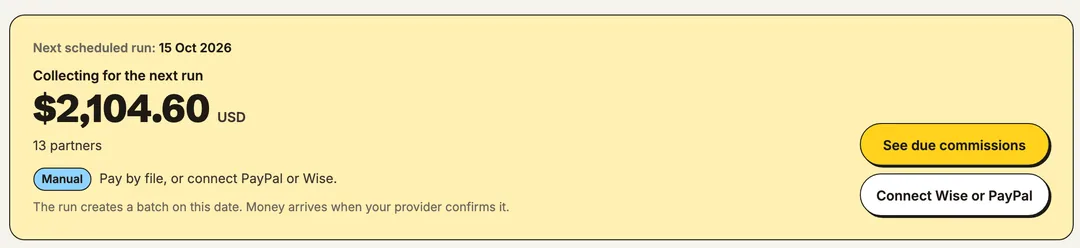
The standard route is fine for a handful of affiliates. Your affiliate tool exports who is owed what. You send it. PayPal pays. Call it twenty minutes a month. You also learn what your payout process involves before you hand it to a machine.
The API route is the same batch with your hands removed. You connect your own business account once. On payday the software works out who is owed what and waits out your holding period. Then it tells your account to send the batch. On AffiliateRail this is how automated payouts run. Your account, your PayPal fees, and nothing passing through AffiliateRail on the way. A payout fee is a slice a tool takes out of the money you send your affiliates. That is why there is no payout fee on any plan here. The custody page explains what changes when a tool holds the money instead.
Whichever route you take, the account is yours. With PayPal you are the sender of record, and PayPal's fee lands on your account.
When is PayPal the wrong choice?
In shortWhen most of your affiliates are paid in a currency other than yours. The 4.00% spread is the cost that grows with an international program. Wise charges from 0.24% instead. And when PayPal cannot convert into an affiliate's currency, as with the three named above.
For example, say a program pays $5,000 a month to affiliates in Europe and Asia. If every payment converts, it loses about $200 a month to the spread. Over a year that is a good affiliate's whole commission. The Wise integration exists for that program. Many founders run both. PayPal for affiliates who ask for it, Wise for the rest.
The honest summary. PayPal reaches the most people and is the simplest to start on. It is cheap for dollar payments to the US. It is expensive, quietly, for payments that change currency. Know which of those your program is before you pick.
Pay affiliates from your own PayPal, on a schedule
Connect your business account, set the payday, and watch a batch leave your own account with nothing taken on the way. Fourteen days, no card.
Every figure on this page was read off PayPal's own pages on the date beside it in the sources. This is PayPal's US fee page, and other countries have their own. PayPal changes them. Read your own account's fee page before you budget. Treat this page as the map, not the territory.
Common questions
Is PayPal Mass Pay the same as PayPal Payouts?
Yes. PayPal's fee page says Payouts includes the service formerly known as Mass Pay. The file upload and the API are two routes into the same product. The fee per payment depends on which route and which currency.
Does the affiliate pay a fee to receive a PayPal payout?
No fee to receive. PayPal's developer FAQ says recipients pay no fee whatever type of account they have. If the payment changes currency, though, the exchange rate includes a 4.00% spread, and that comes off what the affiliate receives.
What is the maximum PayPal payout to one affiliate?
$20,000.00 USD per single payment by default, or the equivalent in local currency. There is no limit on the total size of a batch. For a bigger single payment the FAQ says to contact your account representative or Customer Service.
What happens if an affiliate never claims the payment?
It comes back. PayPal notifies them that money is waiting, and if nobody claims it within 30 days the money is returned to your account. Collect the PayPal email in the affiliate's own portal and confirm it before the first batch.
Does AffiliateRail charge anything on top of PayPal's fees?
No. Payouts run from your own PayPal business account, on your schedule, and never pass through AffiliateRail. PayPal's fees are yours, the same as sending the batch by hand. There is no payout fee on any plan.
Where these facts come from
Fact-checked and reviewed by Jimi Barkway on 6 September 2026. Every figure above was read off the document named here on the date beside it. To contact AffiliateRail about one, email support@affiliaterail.com and the figure is corrected and the date moved.
- PayPal's business fees page, last updated 1 September 2026: Payouts includes Mass Pay, 2% capped by currency, the 0.25 USD API fee, the 20.00 USD international cap, and the 4.00% conversion spread on Payoutschecked 6 September 2026
- PayPal Developer, Payouts FAQ: the sender pays, recipients pay no fee, $20,000.00 per payment, no batch limit, over 156 countries and 23 currencies, the three currencies not convertedchecked 6 September 2026
- PayPal Developer, Payouts payment processing: instant to existing accounts, a notification to others, returned after 30 days unclaimedchecked 6 September 2026
- Wise's business pricing page: sending money from 0.24%checked 6 September 2026
- AffiliateRail's PayPal Payouts integration page: how a batch runs from the merchant's own business accountchecked 6 September 2026