In brief
Affiliate onboarding is a week's work. Of the partners who ever refer, a quarter do it within eight hours of joining, half within seven days and three quarters by day 49. In the median program only 15 of 100 approved partners ever refer at all. So the sequence is five messages. The approval email with the link and the payout terms on day 0, a personal note on day 1, a check-in on day 7, the first payout or pending statement on day 30, and one final question on day 49. Then the founder's time goes to the partners who answered.
No card. Cancel in one click.
What is affiliate onboarding, and why does the first week decide it?
In shortAffiliate onboarding is everything between approving a partner and their first referral. The data says it is a week's work. Of the partners who ever refer anyone, a quarter do it within eight hours of joining. Half have by seven days, and three quarters by day 49. In the median program only 15 of 100 approved partners ever refer at all. So the message you send on day one is worth more than the one you send in month three.
The research method was simple. I took the timing from the largest referral dataset in the category. The questions partners ask came from the FAQs on 200 public program pages, and the reward from 358 program settings. The one thing that made a partner sell harder came from an affiliate who promoted software for years. Then I wrote the sequence those figures imply, with the day each message is sent and the reason. I found that onboarding is not a course. It is five short messages, and the first three matter most.
Three words first. Activation is the share of approved partners who ever send you a single person. A holding period is how long a commission waits before it can be paid, so a refund can cancel it first. And onboarding here means the messages and the setup between approval and that first referral. The dataset puts a clock on all three.
How do I get paid?
| When | What the data says | The message |
|---|---|---|
| Day 0, approval | A quarter of the partners who ever refer do it within eight hours | The link, the rate, the duration, the payout day, one sentence on who to refer |
| Day 1 | One long-time affiliate says he sold harder for merchants who kept in touch personally | A note from the founder, not a template, asking where they plan to put the link |
| Day 7 | Half of the partners who ever refer have by now | Have you placed it? Here is the one asset you asked for |
| Day 30 | The most common holding period is 30 days; how much and when a partner is paid are the two most-asked questions | The first payout, or what is pending and the date it pays |
| Day 49 | Three quarters of the partners who ever refer have by now | Is there anything that would help? Then stop chasing |
What should the approval email say?
In shortThe five things partners ask on the way in. How much they earn, which is the rate and the duration. When they are paid, which is the payout day and the holding period. How they are paid, meaning PayPal, Wise or whatever you use. How to begin, which is the link, ready to paste. And who to refer, in one sentence. Across 200 program pages, 108 of the FAQ questions counted are about the first two.
Let's say your program pays 25% for 12 months with a 30-day hold, paid by PayPal on the last day of the month. The rate, the duration and the hold are the centre of the 358-program dataset; the method and the day are yours. The approval email is six lines. "You are approved. Your link is below. You earn 25% of every payment for 12 months. Commissions are held 30 days for refunds, then paid by PayPal on the last day of the month. The people who buy from us are founders running a SaaS on Stripe. Here is the link."
The link goes in the first email. A quarter of the partners who will ever refer do it within eight hours. A partner who has to log in, locate the resources page and copy a link from there has been assigned a task. A partner with the link in the email has been given a paste. The landing-page article counts the questions this email is answering. The article on what programs pay has the figures behind the rate.
What goes in the day-one note?
In shortA question from a person. Where do you plan to put the link? The one retention lever a long-time affiliate names, from his own years of promoting SaaS, is a merchant who kept in touch personally. Not a bonus, not a contest. A founder who wrote. It is unpaid, and it is the thing the templates cannot do.
Send it from your own email address, with your name on it, rather than from the platform's automated notification sender. A partner who replies should reach a person. That is the whole mechanism, and it costs a founder a couple of minutes per approved partner.
The note is short because it is personal. Two lines: thanks for joining, where are you thinking of putting the link, and is there anything you need from me to do it. The answer tells you which asset to create. A newsletter writer wants a paragraph and a screenshot. A YouTuber wants a demo account. A founder wants a comparison they can forward. Create the particular one they requested, rather than a library.
Only 22 of the 358 public program pages attach creatives on the landing page. The rest keep assets behind the login, which fits making the one asset a partner asks for. They provide the right one on request, because the request tells them which one is right. The first-ten-affiliates module of the manual has two messages in this voice, written out.
What happens on day seven, and day 30?
In shortDay seven is the halfway mark. Half of the partners who will ever refer have done so by then. The message asks whether the link is placed and delivers the asset they requested on day one. Day 30 is the first payout on the most common holding period. Or it is the first statement of what is pending and when it pays. "How much can I earn?" and "How do I get paid?" tie as the most-asked questions, and "When do I get paid?" is close behind. The answer to the last is a date.
The day-30 message matters even when the amount is zero. A partner who referred someone on day nine sees a commission sitting in "pending" for three weeks. They do not necessarily understand why. The holding period is the explanation. Explaining that is the whole message. "Your $12.50 from the sale on the ninth is held until the ninth of next month, in case of a refund. Then it pays with the next run." On a $50 plan at 25%, that is the number. A partner who understands it has no reason to leave over it.
The hold-period page sets the vendors' defaults beside what founders select. The failed payouts article covers the message to send when the payment bounces. That is the other day-30 email nobody anticipates.
When should you stop chasing?
In shortDay 49. Three quarters of the partners who will ever refer have done so by then. The last message is a straightforward question, is there anything that would help. Then the founder's time goes to the partners who responded. In the median program that is 15 of every 100 approved. And 6 of the 100 will bring a paying customer.
For example, imagine you approved forty partners on the first of the month. By the eighth, on the dataset's pattern, about three of the six who will ever refer have already done so. By the nineteenth of the following month, the count of partners who will ever refer is nearly settled, at six or so. The other thirty-four are not late. They are the 85 in 100 the dataset says never begin. A sixth message will not persuade them. Now imagine you omitted the day-one note. The dataset cannot say what that costs, because it measures activation, not messages. The one affiliate on this page who can says it is the reason he sold harder for some merchants than others.
The sequence is deliberately short, and the dataset is the reason. Two things the sequence cannot repair. A rate below the market, which the commission module sets. And a link that breaks in Safari, which the cookieless article covers. Both show up as a partner who placed the link and never earned. No email remedies that.
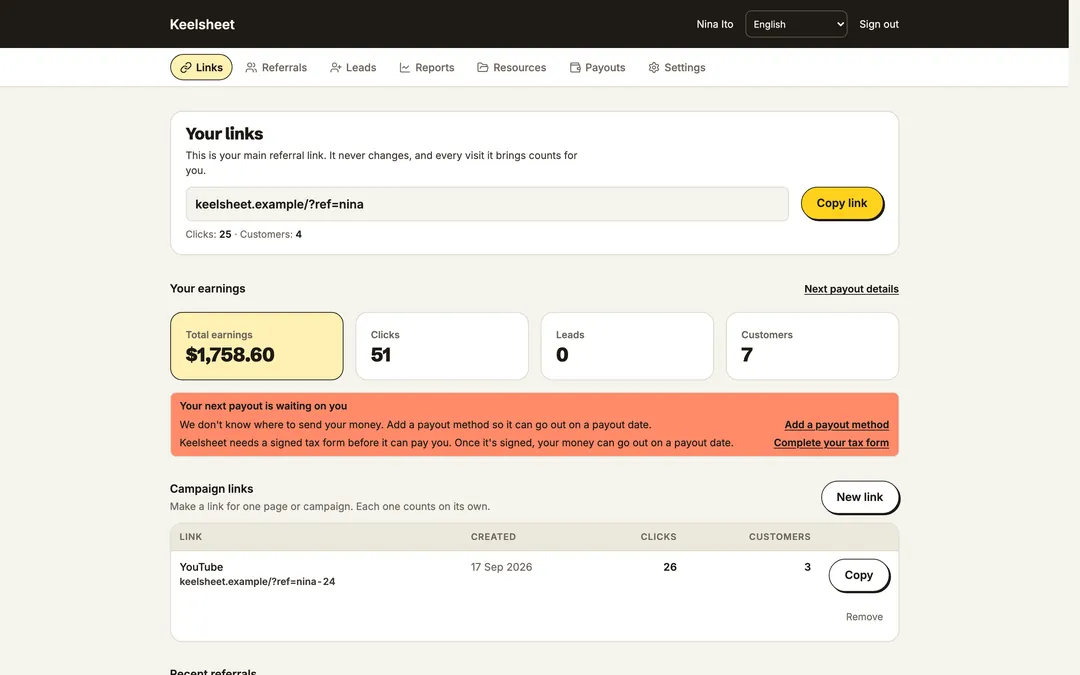
A word on this site's own product, with its trade-offs. AffiliateRail provides every affiliate with a portal on your own domain, from the $29 plan. It carries their link, a resources page and a ledger showing what pays and when. There is also a public page carrying your brand and their name, on the same plan. The transactional emails, approval and payout among them, ship on day one in the product's own template. Your own affiliate emails in your own words are available on the $59 plan and up. The day-one note in this sequence is written by you either way. That is the purpose of it.
The link, the ledger and the payout date on a portal that looks like yours, from $29
Transactional emails on day one, your own affiliate emails from $59, and payouts on a schedule from your own PayPal or Wise at 0%. Fourteen days, no card.
Every dataset figure on this page is from the linked sources on the dates beside them. The sequence is this site's own, timed to those figures. Replace the figures with your program's when you have them.
Common questions
What should an affiliate approval email include?
The link itself, the rate, the duration, the payout day and the hold, how they are paid, and one sentence on who to refer. Across 200 program pages, 108 of the FAQ questions counted are about how much and when a partner is paid. A quarter of the partners who ever refer do it within eight hours of joining, so the link goes in the first email.
How long does affiliate onboarding take?
About seven weeks, and mostly the first one. Half of the partners who ever refer do so within seven days of joining, and three quarters by day 49. That is in a dataset of 31.4 million referrals across 3,425 programs. After day 49 the count of partners who will ever refer is nearly settled.
How many new affiliates actually start?
In the median program, 15 of 100 approved partners ever refer anyone. Only 6.4% bring a paying customer. The middle half of programs sit between 6% and 28% activation. The sequence on this page is targeted at the first week, where the ones who will start mostly do.
What keeps an affiliate promoting?
The one lever a long-time SaaS affiliate names from his own years is a merchant who kept in touch personally. Not a bonus or a contest. That is the day-one note in this sequence. The founder writes it, asking where they plan to put the link.
Where these facts come from
Fact-checked and reviewed by Jimi Barkway on 7 September 2026. Every figure above was read off the document named here on the date beside it. To contact AffiliateRail about one, email support@affiliaterail.com and the figure is corrected and the date moved.
- FirstPromoter's July 2026 referral dataset: 31.4 million referrals across 3,425 programs; 15 of 100 approved partners ever refer, 6.4% bring a paying customer, the middle half between 6% and 28%; a quarter of those who ever refer do so within eight hours, half within 7 days, three quarters by day 49checked 4 September 2026
- The 358-program dataset: median 25% for 12 months, the 30-day hold on 184 programs, 83 auto-approving partnerschecked 7 September 2026
- Dub's partner marketplace sitemap: the 358 program pages whose FAQs and creatives were countedchecked 7 September 2026
- Jimi Barkway's own years as a SaaS affiliate: merchants who kept in touch personally made him sell harder; recurring income, a sticky product and confidence in the product were why he promoted SaaS onlychecked 5 September 2026
- AffiliateRail's home page: the portal on your domain, the resources page, the ledger, the public page per affiliate, the transactional emailschecked 7 September 2026
- AffiliateRail's pricing page: template emails on Launch, your own affiliate emails from Grow at $59checked 7 September 2026