In brief
I counted what 358 public affiliate program landing pages include on the page. 200 include an FAQ. The questions answered most are seven rewordings of how much and when a partner gets paid. 152 carry an earnings calculator, 147 an image, 22 attach banners, none a video. The median page has four blocks. Titles say join, earn, partner and promote; only four mention recurring. The page's purpose is the payout answer, in the partner's order. The dataset is linked.
No card. Cancel in one click.
What should an affiliate program landing page say?
In shortHow much a partner earns, for how long, and when they get paid, before anything else. I counted what 358 public program pages in Dub's marketplace include on the page. More than half include an FAQ. The questions answered most often for partners are about money and timing: "How much can I earn?", "How do I get paid?", "When do I get paid?". Four in ten include an earnings calculator. Six in a hundred attach files such as banners or logos.
The research method was simple. I had already used the same 358 pages to count what programs pay. Each one also carries the page a program displays to a partner before they apply. The pages are assembled from blocks, so I counted the blocks, the FAQ questions, and the words in the titles. I found that the programs converge on a single structure, because the FAQ is a collection of seven ways to ask "when do I get paid", and almost nobody includes creatives on the page. The reward dataset is linked in the sources.
Three words first. A program landing page is the public page where a prospective affiliate reads the offer and applies. An earnings calculator is a widget on that page where they enter a number of referrals and see what they would earn. And a holding period is how long a commission waits before it can be paid. That is why "when do I get paid" is a different question from "how much".
How much can I earn?
| On the page | Pages | Share |
|---|---|---|
| A published application form | 358 | 100% |
| A holding period, from the program's settings | 358 | 100% |
| A reward; 343 of them a sale reward with a duration | 351 | 98.0% |
| An FAQ | 200 | 55.9%; the median FAQ has 4 questions |
| An earnings calculator | 152 | 42.5% |
| At least one image | 147 | 41.1% |
| Attached files, such as banners or logos | 22 | 6.1% |
| A video | 0 | 0% |
| Blocks on the page, median | 4 | The largest page has 14 |
What do partners ask, and in what order?
In shortMoney and timing, seven ways. Across the 200 pages with an FAQ, the most common question is "Ready to start earning?" (23 pages). Then come "How much can I earn?" (22), "How do I get paid?" (22) and "When do I get paid?" (16). Next are "How and when do I get paid?" (15), "How do payouts work?" (14) and "When and how do I get paid?" (11). After those: the question about starting (10), "Who should you target?" (9), "What counts as a successful referral?" (8), "Is there a cost to join?" (8).
The single most common question is not a question at all. "Ready to start earning?" heads the FAQ on 23 pages. Its answer is the apply button, and it is the marketplace's method of ending the page with a request. Copy the idea, not the wording. The last item on the page should be the action you want the partner to take.
Seven of the top twelve are the same question in different words. Add them together and 108 of the counted questions concern the same two things. How much a partner earns, and when the payment arrives, which is the page's entire purpose. Answer those two before anything else, and the partner has what they came for.
Let's say your program pays 25% for 12 months with a 30-day hold. That is the dataset's centre. The first three lines on the page practically write themselves. "Earn 25% of every payment for 12 months." "Paid monthly, 30 days after the sale." "Through PayPal or Wise, to your own account." The article on what programs pay has the figures behind those defaults. The hold-period page has the vendors' settings.
What goes on the page, block by block?
In shortA median of four blocks. A text block on every page. An FAQ on 200 pages. An image on 147, an earnings calculator on 152. Files on 22. No page in the set contains a video. The largest page has 14 blocks, and most remain at four.
The earnings calculator is the block worth copying. On 42.5% of pages a partner can type "ten referrals" and see a number. That answers "how much can I earn" without a paragraph, because the reward is a percentage of a known price. Let's say your plan is $50 a month at 25% for 12 months. Ten referrals who remain for the year is $1,500. The calculator displays it on the page.
The image block is on 147 pages, and it is the page displaying what the partner would be promoting. A partner who discovered the page from the marketplace rather than from your site has never encountered it.
The files block is the surprising one. Only 22 pages, 6.1%, attach banners, logos or copy on the landing page. The remaining 336 put nothing on the page. On Dub, creatives live in the portal's resources area. That is where an approved partner searches for them. So the landing page is for the decision to apply, and the portal is for the work following approval. The two are different pages with different purposes.
What do the titles say?
In shortJoin, earn, partner, promote. Across 358 titles the most common words are "program" (72), "join" (66), "partner" (49), "promote" (39), "affiliate" (38) and "earn" (30). "Paid" appears in 11, "recurring" in 4, "lifetime" in 4. The titles that name the reward are unusual and specific: "Earn 10% lifetime. Forever." and "Turn your network into recurring income."
The typical title is a label: "Join the Anagram affiliate program", "Why Promote Agent Media?". It tells a partner what the page is and nothing about the offer itself. The unusual title places the reward in the opening line. On a marketplace where a partner scrolls past dozens of programs, the reward in the title is the one thing that distinguishes a page from its neighbours. This page cannot say which title converts better, because the marketplace publishes no application counts. It can say which is less common.
A recurring commission is one paid on every renewal rather than once. Of the 343 programs that pay per sale, 164 operate theirs for 12 months. Yet "recurring" appears in only four titles. So the term describing the reward sits in the settings rather than the title.
What should you leave off?
In shortThe long "why us". Answer the partner's questions in the partner's order, then stop. The activation data says the page has a week to deliver. Half of the partners who ever refer do so within seven days of joining. Only 15 of 100 approved partners ever refer at all.
For example, imagine a page with five blocks. A title that names the reward. A three-line summary of how much, for how long, and when the partner is paid. An earnings calculator. A four-question FAQ answering how to begin, who to refer, what counts as a referral, and whether it costs anything. And the apply button. That is the structure the marketplace has adopted, and a founder can assemble it in an afternoon. Now imagine including a video. No page among the 358 contains one. That does not mean it would not work, only that nobody has tested it here.
The one-week guide positions the page in the launch order. The first-ten-affiliates module of the manual describes what happens in the seven days after someone applies. The page cannot handle that part for you.
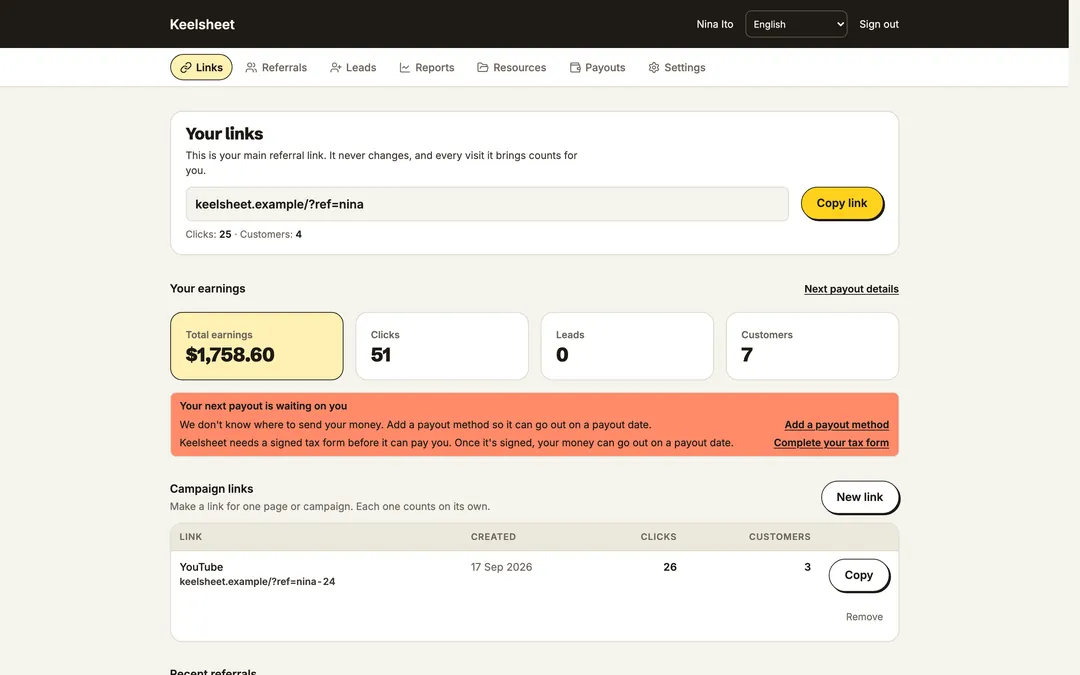
A word on this site's own product, with its trade-offs. AffiliateRail provides every affiliate with a public page carrying your brand, their name and their link. Its own program page prints the rate, 30% for as long as the customer stays, and how a commission matures. It has no marketplace, so your program page is a page on your own site rather than one of 358 in a directory. The partners who discover it are the ones you direct there. It takes 0% of every payout and pays from your own PayPal or Wise on a schedule from the $59 plan.
A program page and a page per affiliate, from $29 a month
The rate, the hold and the payout method printed the way partners ask for them, and payouts from your own PayPal or Wise at 0%. Fourteen days, no card.
Every count on this page was calculated from the 358 pages on 7 September 2026. The reward figures come from the dataset linked in the sources. The block, FAQ and title counts were made from the same 358 pages. Pages change, so check before you quote a figure twelve months from now.
Common questions
What should an affiliate program landing page include?
The reward, its duration and the payout timing first. Of the FAQ questions counted across 200 program pages, 131 are about how much and when a partner is paid. Then how to begin, who to refer, what counts as a referral, and whether it costs anything. An earnings calculator is on 42.5% of pages. An FAQ is on 55.9%.
Should the page have an earnings calculator?
152 of 358 pages include one. It answers the most-asked question, how much can I earn, with a number instead of a paragraph. It works because the reward is a percentage of a known price.
Should creatives go on the landing page?
Only 22 of 358 pages attach files there. The remainder keep banners, logos and copy in the portal's resources area, behind the login. That is where an approved partner searches for them. The landing page is for the decision to apply.
What should the title say?
The reward, if you want to stand out. Across 358 titles the common words are program, join, partner, promote, affiliate and earn; recurring and lifetime appear in four titles each. The marketplace prints no application counts. So this page can say which title is less common, not which converts better.
Where these facts come from
Fact-checked and reviewed by Jimi Barkway on 7 September 2026. Every figure above was read off the document named here on the date beside it. To contact AffiliateRail about one, email support@affiliaterail.com and the figure is corrected and the date moved.
- The 358-program dataset: the reward, duration, holding period and discount on each page, and the page URLs the block counts were made fromchecked 7 September 2026
- Dub's partner marketplace sitemap: the 358 program pageschecked 7 September 2026
- FirstPromoter's July 2026 referral dataset: 15 of 100 approved partners ever refer, half of them within 7 dayschecked 4 September 2026
- AffiliateRail's own program page: the rate and how a commission matures, printed on the pagechecked 7 September 2026
- AffiliateRail's home page: a public landing page per affiliate carrying the merchant's brandchecked 7 September 2026