In brief
All eleven tools checked publish an API. Nine publish a rate limit, from about 17 a minute on impact.com's default to 4,000 on PartnerStack, with AffiliateRail and Tolt at 25 a second. Most sign you in with a Bearer key. Two use HTTP Basic. A rate limit is how many requests the tool answers in a given time before it refuses. The write side differs most. Two references promise a retried request will not double. Three publish OpenAPI. Eight carry an llms.txt index. Four name an MCP server.
No card. Cancel in one click.
Which affiliate software has an API?
In shortAll eleven tools I checked publish one. The differences are elsewhere. How you sign in. How many requests you may make. What you are allowed to write, not only read. And whether the tool publishes a contract a machine can read. That is what lets a typed client or an AI assistant use it without guessing.
The research method was simple. I read the API reference of eleven affiliate tools on 6 September 2026, starting with the authentication and rate-limit pages. I found eleven APIs and nine published rate limits. Three publish OpenAPI. Eight carry an llms.txt index. Four name an MCP server. Two promise a safe retry. The links are in the sources.
Five words first. An API is a way for your own code to read and change your affiliate program without opening the dashboard. An API key is the secret string that proves the request is yours. A rate limit is how many requests the tool will answer in a given time before it refuses. A webhook is the reverse: the tool calls your server when something happens. And OpenAPI is a standard file that describes every endpoint, so tools can generate a client from it.
An Idempotency-Key header on any POST replays the first response for 24 hours; the same key with a different request is a 422
| Tool | How you sign in | Published rate limit | Per minute | Also publishes |
|---|---|---|---|---|
| AffiliateRail | Bearer key, rail_live_ or rail_test_, with scopes | 25 requests a second per key | 1,500 | OpenAPI at /v1/openapi.json; four llms.txt files; an MCP server that also sets up the program, sign in with no key; signed webhooks; Idempotency-Key |
| Tolt | Bearer key from Settings, Integrations | 25 requests a second per key | 1,500 | llms.txt index; six objects with list, retrieve, create, update and delete; a mention of webhooks |
| Rewardful | HTTP Basic, the API secret as the username | 45 requests per 30-second window | 90 | llms.txt index; signed webhooks; seven resources |
| Dub | Bearer key, dub_ | 60 a minute Free, 600 Pro, 1,200 Business, 3,000 Advanced | 60 to 3,000 | Server, web and mobile SDKs; webhooks; an MCP server; llms.txt |
| FirstPromoter | Bearer key (v2); X-API-KEY header (v1) | 400 requests a minute per account | 400 | A tracking API for sales, refunds, upgrades and cancellations; webhooks v2; an experimental MCP server; llms.txt |
| Tapfiliate | X-Api-Key header | Headers only, no number printed | Not published | Create a conversion, add commissions, approve or disapprove a commission, create an affiliate, create a payment; an external webhook feature |
| PartnerStack | Bearer on the Partner API; separate Vendor authentication | 4,000 a minute per IP address | 4,000 | llms.txt with the endpoints in OpenAPI; deals, transactions, a Convert a customer call, webhook endpoints |
| impact.com | HTTP Basic, Account SID and Auth Token, with scoped tokens | 1,000 an hour by default | About 17 | A separate 3,600 an hour limit on /Catalogs; webhooks; llms.txt |
| Reditus | Documented on its authentication page | A rate-limits page, no number quoted here | Not quoted | llms.txt index with OpenAPI specs; webhooks; Create Payment, Track Conversion, Churn, Refund |
| Refgrow | Bearer key, rgk_ | 100 requests a minute per key | 100 | A conversions endpoint with a reference field that acts as an idempotency key; webhooks; an MCP server |
| Endorsely | Bearer key | 100 requests a minute per organisation | 100 | A Track Referral endpoint for paid conversions and free signups |
How do you sign in?
In shortMost with a Bearer key in the Authorization header. Two with HTTP Basic, where the key goes in the username field. One with a custom header. The shape matters less than what the key can do. Two references on the table say their keys carry scopes.
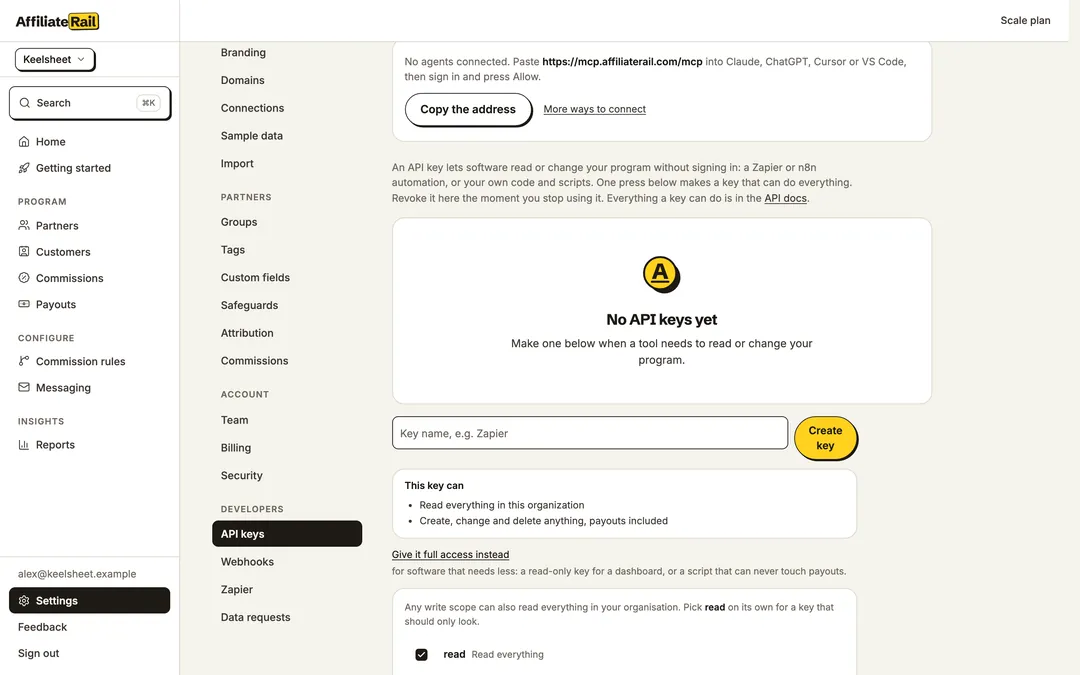
The Bearer group is AffiliateRail, Tolt, Dub, FirstPromoter's v2, Refgrow, Endorsely and PartnerStack's Partner API. AffiliateRail's keys are minted under Settings, API keys, "and carry scopes". A test key, rail_test_, works against the same organisation. It stamps a livemode header of false. Dub's keys start dub_. Refgrow's start rgk_. Tolt's come from Settings, Integrations. The PartnerStack review covers the rest of what it does.
The Basic group is Rewardful and impact.com. Rewardful's page says to "provide your API Secret as the basic auth username value". There is no password. It is "similar to how Stripe authenticates". impact.com's token has two parts: an Account SID as the username and an Auth Token as the password. Its page says to "use scoped tokens instead of full-access tokens", and that tokens made before April 2025 offer only read-only or read-write. Tapfiliate is the custom-header case, with X-Api-Key on every request. FirstPromoter's older v1 used X-API-KEY the same way.
For example, imagine you want a dashboard that reads commissions and nothing else. On a keyed API with scopes, you mint a read-only key and the dashboard cannot write. AffiliateRail and impact.com both say so. Two say the opposite in plain words. Tolt: "Each API key has full access to all API endpoints." Rewardful: "Your API Secret grants full access to your Rewardful account." On the rest, the pages fetched do not say. So the safety is in your own code until you check. That is the difference scopes make.
How many requests can you make?
In shortNine of the eleven publish a number. Converted to a minute, they run from about 17 on impact.com's default to 4,000 on PartnerStack. AffiliateRail and Tolt both allow 25 a second, which is 1,500 a minute. Refgrow and Endorsely each allow 100 a minute. Every tool that publishes a limit returns a 429 status when you cross it.
AffiliateRail's limit is "enforced as a token bucket that refills continuously, so short bursts above the rate are fine as long as the average holds". Every response carries X-RateLimit headers with the bucket size and what is left. Tolt's limit is the same 25 a second, per key, with a 429 and a JSON error body above it.
Rewardful's is, "in most cases", "45 requests per 30 second window", which is 90 a minute. Its page asks you to treat that as an absolute maximum. Dub's is "capped at 60 requests per minute per key on the Free plan", then 600 on Pro, 1,200 on Business and 3,000 on Advanced. FirstPromoter's is "400 requests per minute per account". PartnerStack's is "4000 requests per minute per IP address". impact.com's is "1,000 requests per hour" by default. One catalogue endpoint gets 3,600 an hour. Refgrow's is "100 requests per minute per API key". Endorsely's is "100 requests per minute per organization".
Let's say you sync commissions once a night for a program with a few thousand sales a month. None of these limits bites. Now let's say you poll every minute for live numbers on a screen. On impact.com's default you get about 17 calls a minute. One screen is fine. Ten are not. On Rewardful, 90 a minute. On the two 25-a-second APIs, the screen is not the constraint. Match the limit to how you will call it, not to the biggest number.
What can you write, and is it safe to retry?
In shortEvery one of them can read. The differences are on the write side. Whether you can record a sale from your own backend. Whether you can mark a refund or a churn. And whether a retried request creates a duplicate. Two references on the table promise it will not, in two different shapes.
AffiliateRail's rule is on its API overview. "An Idempotency-Key header on any POST replays the first response for 24 hours; the same key with a different request is a 422". So if your server times out and sends the same request again, nothing doubles. Its rate-limits page says to use it "on anything that must not happen twice: creating sales, partners, or payout batches". That is what makes a retry loop safe to write.
Refgrow's shape is a field, not a header. On its conversions endpoint, the reference field "also acts as an idempotency key. Sending the same reference twice returns the original conversion instead of creating a second one, so a retried webhook cannot pay an affiliate twice." Same promise, scoped to one endpoint. On the other nine, the pages fetched make no promise, so build the check yourself.
The write surface elsewhere. Reditus's affiliate program API has Create Payment, to "add payments for your referrals/leads", a v2 Track Conversion, a Churn Referral call, and Create Refund. That is the API its Paddle and Chargebee pages point at. Reditus has no connector for either. FirstPromoter's API page: "Our API allows you to track sales, refunds, upgrades and cancellations even if you have a billing provider we do not support." Endorsely's Track Referral "records a conversion from an affiliate referral", with an amount in cents. Refgrow's conversions endpoint is "to record conversions from your backend". Dub's can "track lead and sale events". PartnerStack has a Create a transaction call and a Convert a customer call.
Tolt's six main objects, partners, customers, links, commissions, transactions and promotion codes, each have list, retrieve, create, update and delete. Programs is list only. Clicks is create only. Transactions adds a refund. Tapfiliate's reference is wide on the write side. Create a conversion, add commissions to it, approve or disapprove a commission, create an affiliate, create a payment, and create a click.
Rewardful's resources are campaigns, affiliates, affiliate links, affiliate coupons, referrals, commissions and payouts. PartnerStack's reference leads with deals: create, update, assign a partnership, archive. Dub's Partners API covers partners, applications, tracking, customers, commissions, payouts and discount codes. AffiliateRail's page says the API can create sales, partners and payout batches.
Which ones publish a contract a machine can read?
In shortThree publish OpenAPI. AffiliateRail at /v1/openapi.json, generated from the running code. PartnerStack inside its llms.txt. Reditus as a set of OpenAPI specs in its index. Eight of the eleven carry an llms.txt index. Four name an MCP server: AffiliateRail, Dub, Refgrow, and FirstPromoter's, which it marks experimental.
The OpenAPI file is the practical one. AffiliateRail's page says the reference is generated from the OpenAPI document the API publishes, "so it cannot drift from the running product". Its clients page shows the pairing it uses itself. openapi-typescript for the types, openapi-fetch for the calls. The page calls it "a thin, fully typed fetch wrapper with no codegen beyond one .d.ts file". So a TypeScript app gets typed calls in minutes, from the same file the product runs on.
An MCP server is a service that lets an AI assistant use a product's tools in plain language. Claude and ChatGPT are two such assistants. AffiliateRail's has 44 tools, 22 read and 22 write. Say "set up my affiliate program" and it works through the setup steps with you. You sign in and press Allow, with no key to paste. Before any write, "the server sends back a confirmation card". It shows names, amounts and a list of what would change. Nothing touches payouts or moves money. Dub's integrations page names its MCP server, signed in through an OAuth app. Refgrow's docs list an MCP server under its API. FirstPromoter's list one too, marked "Experimental", with an "Available Tools" page.
The llms.txt files are for the same audience. Tolt, Rewardful, Reditus, PartnerStack, Dub, FirstPromoter and impact.com each carry one that indexes their docs for an assistant to read. AffiliateRail publishes four: the API index, a full-text version of every route, the webhook catalogue, and the docs suite. PartnerStack's adds a Markdown copy of each page. If you plan to have an assistant write your integration, check for that file first.
What about webhooks?
In shortNine of the eleven show them on the pages fetched. AffiliateRail signs every delivery with a Rail-Signature header and gives partners the same mechanism as postbacks. Rewardful's developer centre has a signed-webhooks section. FirstPromoter's v2 webhooks page covers delivery tracking and retries. Dub, PartnerStack, impact.com, Refgrow and Reditus list webhooks in their references. Tapfiliate offers an external webhook feature beside Zapier and Make.
AffiliateRail's page: "AffiliateRail sends a signed HTTP POST to your endpoint when something happens in your program". You add an endpoint under Settings, Webhooks, and tick the event types. The signature header carries a timestamp and a version-one hash. Your server can verify the message came from AffiliateRail, not from anyone who found the URL. The webhooks page has the event list.
Rewardful's reference has webhook endpoints, requests, event types and a signed-webhooks page. Tapfiliate's help centre says you can integrate "via Tapfiliate's external Webhook feature", or through Zapier or Make. Tolt's rate-limit page tells you to use webhook notifications instead of polling, so it has them, on a page I did not fetch. Endorsely may too. Absence from this page is not absence from the product.
Which one should you pick?
In shortFor a typed client from a live contract, AffiliateRail's OpenAPI file, generated from the running code. For a retry that cannot double, AffiliateRail's header on every POST, or Refgrow's reference field on conversions. For recording sales from a billing system nobody supports, Reditus's Payments API, FirstPromoter's tracking API, or Endorsely's Track Referral. For the widest SDK set, Dub. For volume, PartnerStack's 4,000 a minute, with the warning that going over it may get the IP address temporarily blocked.
The API is rarely the reason to choose a tool. It is the reason a tool becomes hard to leave. So before you build on one, read its limit, its write surface and its retry rule. Check whether you can export everything through it. The API integration page and the MCP page have AffiliateRail's in full. The Tolt and Dub pages cover the two with the closest developer surfaces.
A typed client in minutes, and retries that cannot double
An OpenAPI file generated from the running code, 25 requests a second, an Idempotency-Key on every POST, and an MCP server with guarded writes. Fourteen days, no card.
Every figure on this page was read off the vendor's own API reference on the date beside it in the sources. Limits change with plans and over time. Read the reference before you build.
Common questions
Which affiliate software has the highest API rate limit?
Of the nine that publish one, PartnerStack, at 4,000 requests a minute per IP address. Dub's Advanced plan allows 3,000 a minute, its Business plan 1,200, Pro 600 and Free 60. AffiliateRail and Tolt each allow 25 requests a second per key. That is 1,500 a minute. FirstPromoter allows 400 a minute per account. Refgrow and Endorsely each allow 100 a minute. Rewardful allows 45 per 30-second window. impact.com allows 1,000 an hour by default.
Which affiliate APIs publish an OpenAPI file?
AffiliateRail, at api.affiliaterail.com/v1/openapi.json, generated from the running code. PartnerStack, whose llms.txt carries its endpoints in OpenAPI. Reditus, whose llms.txt lists OpenAPI specs per resource. Eight of the eleven carry an llms.txt index of their docs for an assistant to read.
Can I record a sale through the API from a billing system the tool does not support?
On most of them. Reditus has Create Payment and Track Conversion, the route its Paddle and Chargebee pages point at. FirstPromoter's API covers sales, refunds, upgrades and cancellations. Endorsely's Track Referral takes an amount in cents. Refgrow has a conversions endpoint. Tolt has Create Transaction. Tapfiliate has Create a conversion. PartnerStack has Create a transaction and Convert a customer. Dub can track lead and sale events. AffiliateRail's API can create sales, and its Idempotency-Key header keeps a retried request from creating a second one.
Which affiliate software has an MCP server?
Four name one. AffiliateRail, with 44 tools, 22 read and 22 write. It sets up the program as well as running it, you sign in with no key, every write shows a confirmation card first, and nothing touches payouts or moves money. Dub, signed in through an OAuth app. Refgrow, listed under its API docs. FirstPromoter, marked experimental, with an available-tools page.
Where these facts come from
Fact-checked and reviewed by Jimi Barkway on 7 September 2026. Every figure above was read off the document named here on the date beside it. To contact AffiliateRail about one, email support@affiliaterail.com and the figure is corrected and the date moved.
- AffiliateRail docs, API overview: Bearer keys with scopes, test keys, the Idempotency-Key rule, 25 requests a second, the OpenAPI documentchecked 6 September 2026
- AffiliateRail docs, rate limits: the token bucket and the X-RateLimit headerschecked 6 September 2026
- AffiliateRail docs, typed clients: openapi-typescript and openapi-fetch from the OpenAPI documentchecked 6 September 2026
- AffiliateRail docs, MCP: 22 read tools and 22 write tools, setup by agent, sign-in with no key, the confirmation card, what is never exposedchecked 6 September 2026
- AffiliateRail docs, webhooks: signed delivery, the Rail-Signature header, partner postbackschecked 6 September 2026
- Tolt docs: Bearer authentication and full-access keys (authentication.md), 25 requests a second (rate-limit.md), and the llms.txt index of its objectschecked 6 September 2026
- Rewardful developer centre, REST API overview: Basic auth with the API secret, 45 requests per 30 seconds, the resources, signed webhooks, the llms.txt indexchecked 6 September 2026
- Dub docs, rate limits: Bearer keys, 60 a minute Free, 600 Pro, 1,200 Business, 3,000 Advanced; the integrations page for the MCP serverchecked 6 September 2026
- FirstPromoter docs, API v2 introduction and the API billing page: Bearer keys, 400 requests a minute, the tracking APIchecked 6 September 2026
- Tapfiliate developer docs, REST API: the X-Api-Key header, rate-limit headers, customer endpointschecked 6 September 2026
- PartnerStack docs, API reference and rate limits: 4,000 a minute per IP, Partner and Vendor authentication, Deals endpoints, the llms.txt with OpenAPIchecked 6 September 2026
- impact.com Integrations Hub, authentication and rate limits: HTTP Basic with Account SID and Auth Token, 1,000 an hour, 3,600 on Catalogschecked 6 September 2026
- Reditus docs, llms.txt index: the affiliate program API's authentication and rate-limit pages, Create Payment, Track Conversion, Churn, Refundchecked 6 September 2026
- Refgrow docs, API reference: Bearer keys prefixed rgk_, 100 requests a minute, the conversions endpoint and its reference field as an idempotency key, webhooks and the MCP server in the navigationchecked 6 September 2026
- Endorsely docs, API reference: Bearer keys, Track Referral, 100 requests a minute per organisationchecked 6 September 2026
- Tapfiliate help centre: Zapier, Make and the external webhook featurechecked 6 September 2026
- impact.com Integrations Hub, Agency API authentication: Account SID and Auth Token, scoped tokens, legacy tokens before April 2025checked 6 September 2026
- Dub docs, API introduction: the Partners API, webhooks, tracking lead and sale events, the llms.txt indexchecked 6 September 2026
- FirstPromoter docs, API billing page: tracking sales, refunds, upgrades and cancellations for an unsupported billing provider; the MCP Server (Experimental) and Webhooks v2 entrieschecked 6 September 2026
- AffiliateRail docs, typed clients: the four llms.txt fileschecked 6 September 2026
- FirstPromoter docs, API v2 authentication: Authorization: Bearer with the API keychecked 7 September 2026